Pressure Proof Tip with Daniel Stewart: Fears and Our Inner Flinstones

Last month we began discussing the fact that many of the fears we experience today can be attributed back to the survival instinct born in all of us thousands of years ago. We even talked about how the fear of being watched (the spectator effect) can be attributed back to the fear our caveman and cavewoman ancestors experienced when they felt they were being watched because back then the eyes that were watching them were probably judging, evaluating and preparing to attack them!
Fast forward a few hundred thousand years and we’re still stuck in the same rut; when we feel eyes on us we instinctually believe they’re judging, evaluating and preparing to hurt us! Even though our rational brains know better, our two-hundred-thousand-year-old threat system is still given priority (just in case) and we end up riding like fearful cavemen and cavewomen.
This misfiring-wiring problem in our evolutionary-threat-response system might seem like a bit of an outlier or a one-in-a-million, but it’s actually much more common than you might think. In fact, that misfired-wired thing might just be the cause of every single fear we experience today, both inside and outside the arena. So this month let’s take a look at a few other common fears and see if they can also be traced back to our inner Flintstones.
One of our most common fears is the fear of failure. The fear of doing our best, but it not being good enough. The fear of giving 100%, but still coming up short… and guess what? It’s caused by our inner Flintstone! You see, back then cavemen and cavewomen couldn’t afford to make too many failed attempts, choices or actions. If they ate the wrong plant, crossed the wrong river, or challenged the wrong predator, failure would have some really serious consequences. Fast forward to today and that survival instinct still makes us wary of any action that could lead us to fail. From raising our hands in class, to participating in clinics, to moving up a level, we’ve all learned to fear failure because our brains have been conditioned to view failures as threats—rather than what they really are—opportunities and information.
Another fear many of us share is the fear of being embarrassed. Finishing last in a class, falling in front of the spectator section, or being eliminated are common thoughts many of us experience… and guess what? Yup, it’s our caveman and cavewoman’s fault again! The rationale behind this is the realization that humans are actually quite helpless, squishy and weak. We don’t have fangs, talons or poison to defend ourselves, so thousands of years ago we learned that the only real way to protect ourselves was to become part of a group. Social grouping is a survival instinct and one that is on display in every school, barn and workplace in the world. We protect ourselves and find safety by becoming part of a group. Even being a member of the USEA is a partially subconscious attempt to surround ourselves with like-minded people in an attempt to fit in and feel safe. Unfortunately, back in the Flintstone days, if we were the slowest, fell a lot, or made too many mistakes, we risked being kicked out of the group, which again would have some really serious consequences. Fast forward to today and that fear still exists because our brains still interpret embarrassing actions as potential reasons we might get kicked out of the group.
I guess what I’m saying is that many of our most common fears aren’t really our fault. They’re the fault of a faulty survival instinct that hasn’t evolved even though safety has, but if we can just remember this and remind ourselves of it often, we can take away much of the power that fears hold over us.
So this month, let’s all have a conversation with our inner caveman and cavewoman and remind them that we aren’t weak or wrong or cowards just because we feel fear from time to time. When we disconnect ourselves from our fears and remember that they’re a normal part of being an abnormal human, we can remove much of the sting and stigma they so often inflict upon us.
I hope you enjoyed this month's Pressure Proof tip. If you’re a trainer and find value in mental coaching, please consider taking my instructor clinic course this fall—or its online version. It'll be taking place Nov. 21–23 in Lorton, VA. For more info, visit https://www.pressureproofathlete.com/coaching
Related Articles

Centerline Success : An Afternoon of Learning, Insight, & Inspiration at Devon
Center Line Success, sponsored by Team Tate Academy and hosted by USDF, provided its 80 attendees with a wealth of knowledge to put into practice. Jeanne McDonald, USEF “S” Dressage judge, and Heather Gillette, USEF “S” Eventing judge, generously took time out of their day to present and all atte...
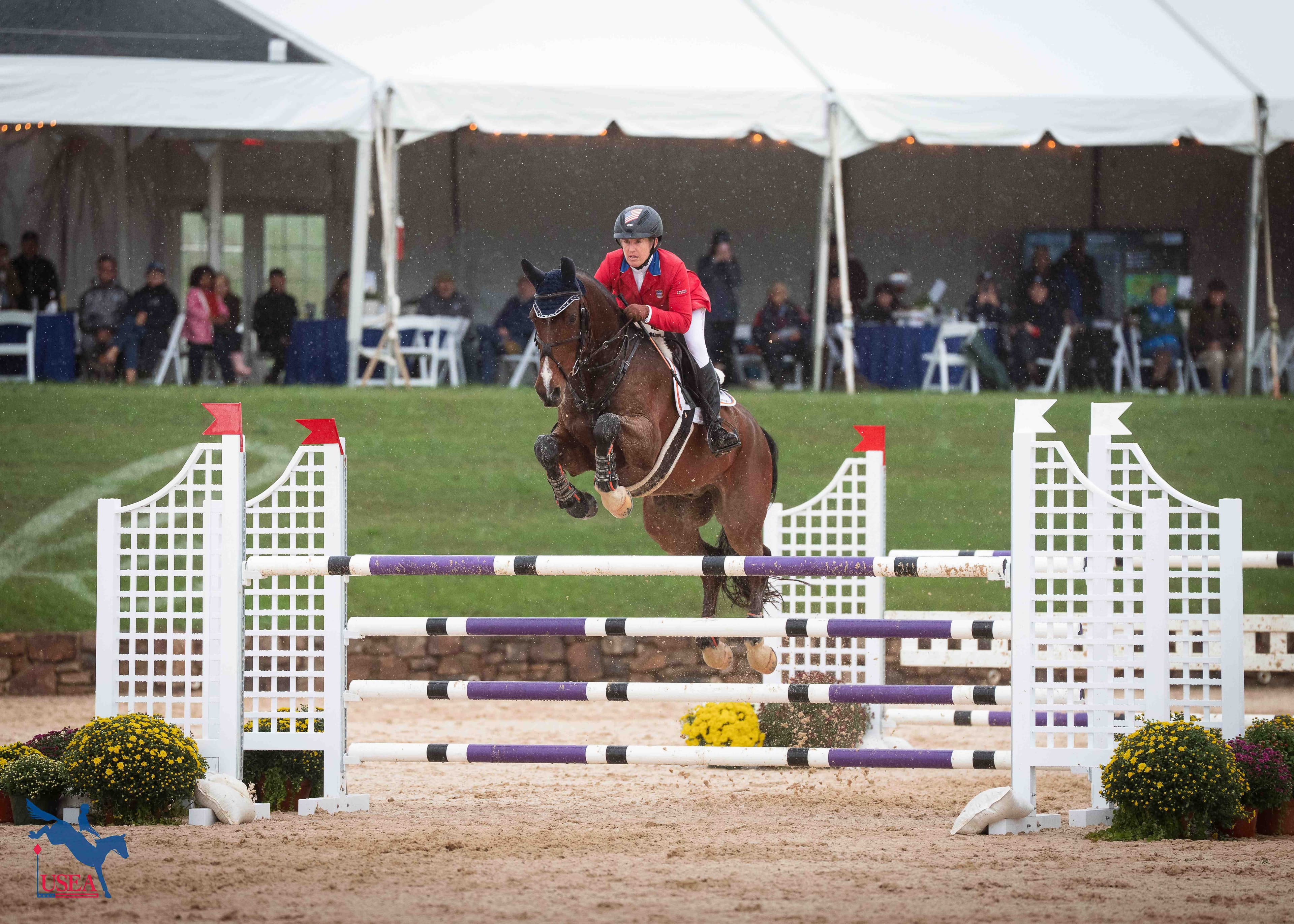
Sharon White and Claus 63 Capture the Win in the US Equestrian Open Final CCI4*-L, White Becomes First Woman to Win the Title
The second edition of the $200,000 US Equestrian Open Eventing Final concluded at Morven Park International Equestrian Center with Sharon White (Summit Point, W.V.) and Claus 63 delivering a standout performance in the final jumping phase to capture the win. It was a historic result as White beca...

The Dutta Corporation Continues Support of USEA Young Event Horse Program in 2026
The United States Eventing Association (USEA) is pleased to welcome back The Dutta Corporation as a valued supporter of the USEA Young Event Horse (YEH) Program and the 2026 USEA Young Event Horse Championships. The Dutta Corporation will return...