The VAP Series – Dressage Scribes
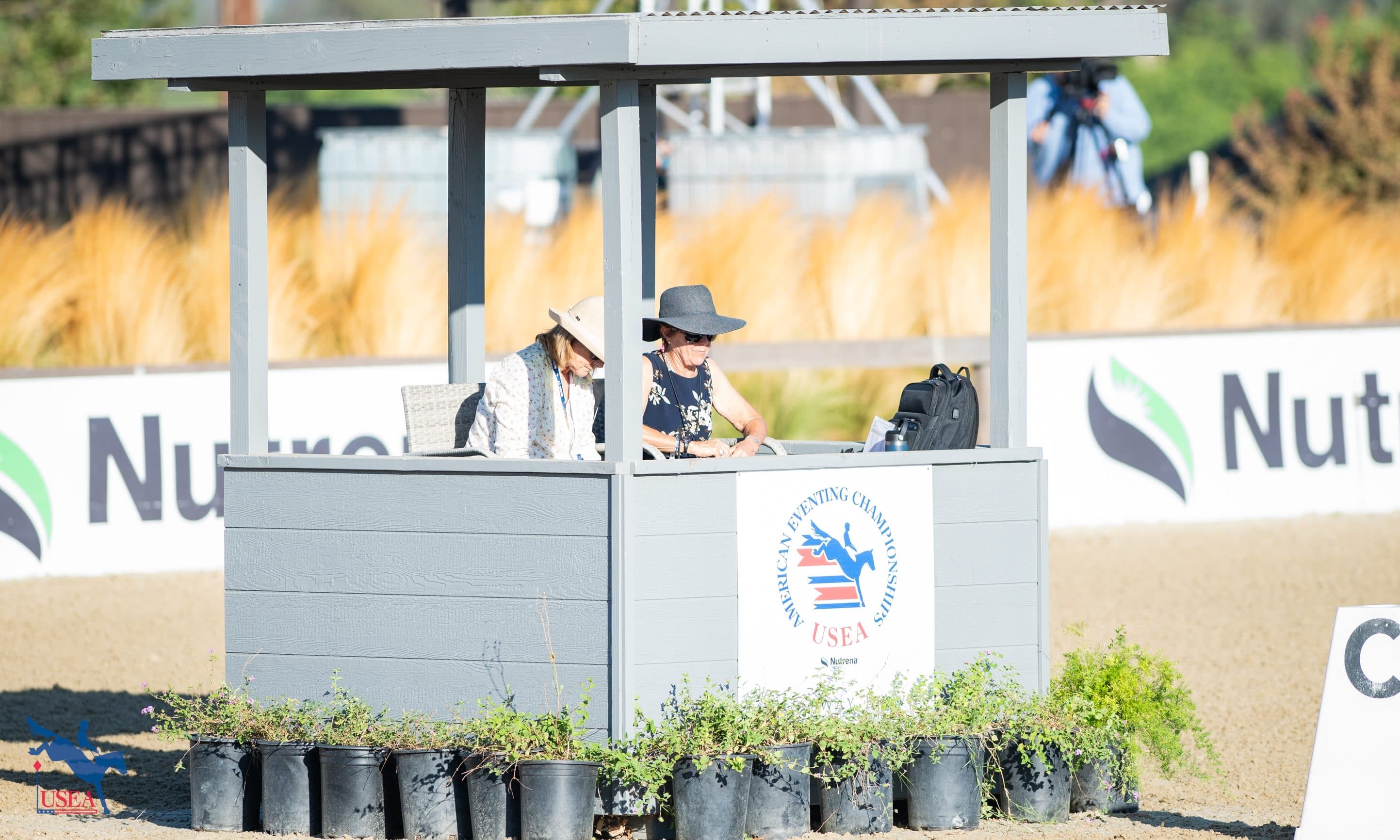
The USEA Volunteer Achievement Program (VAP) was created by the Volunteer Committee in 2025 to recognize the sport’s volunteers for their education, experience, responsibility, and commitment in different roles offered at Recognized Events. Throughout this year, the USEA will be giving you a sneak peek into the tips and tricks to succeed in each of these roles, so you can go earn your next VAP Badge!
In the third edition of the VAP Series, we will be highlighting the role of Dressage Scribe. Frequently coined as the role that most improves a competitor’s own riding, scribing for the dressage phase is an excellent way to see a test through the judge’s eye and increase your scores the next time you trot down centerline! While this may be one of the more technical roles at an event, being a Dressage Scribe is a great way to get more familiar with the sport, its rules, and the key players in event officiating.
How Do I Prepare to be a Dressage Scribe?
Beyond the USEA’s position videos and checklists, there is some studying that you should undertake before you arrive at an event to scribe. To best support the judge, it is recommended that you know the dressage tests that will be used for each level and study them prior to the start of competition, so you have a basic understanding of the movements and flow of the test. This will help you keep track of the comments as the judge dictates them to you throughout each ride.
A basic knowledge of common dressage language and scribe abbreviations will also help when your shift starts, as some judges can speak quickly and these tools can make you more efficient in your role. The United States Dressage Federation (USDF) provides a list of common abbreviations in their “Guide for Scribes,” which is linked here and shown to the right.
Once you’ve prepared and arrived at the venue, you will need to check in and pick up your materials from the Volunteer Coordinator. At a minimum, you will need a clipboard with the dressage order-of-go, score sheets, a radio, and pens with at least one red pen for marking errors. At your station, which is typically in the judging booth by the ring, you will want to organize your materials, mute your cell phone, review the order of go, and check the scoresheets against the order. You will need a sheet for every competitor and some extras. Most events will provide pre-printed labels with each competitor’s name and number, and sometimes, they will already be affixed to the sheets.
When the judge arrives, be sure to introduce yourself and take the time to ask any questions you may have before the competition starts. Every judge may have a slightly different way for you to write down the comments, scores and penalties, so you will need to get to know your judge and determine the procedures they would like you to follow.
What is My Job as a Dressage Scribe?
Your job as Dressage Scribe is to write down the scores and comments made by the judge during a dressage test. The comments should be transcribed exactly as the judge says them. You cannot add anything to the judge’s comments. Each time a competitor is preparing to enter the ring for their test, check their bridle number and ensure that they are next in the order of go and that you have their scoresheet ready. While you are scribing, be sure to write legibly so the judge and the competitor can read the scores and comments after the test is completed.
Be sure to remind the judge if a score or comment is missing or ask if a comment does not match the movement on the sheet. Some judges may give the scores and comments out of order, so do your best to keep track as they dictate.
Once the test is completed, you will hand the sheet to the judge to review and sign. It is important to make sure their signature is on each sheet before you fold it in half and keep it secure for the score runner to collect. You will repeat these steps with each test until the order to go is completed, handing signed score sheets to the score runner as they come by throughout the day, then you’ll return your materials to the show office once the day is over before departing.
Why Should I Serve as a Dressage Scribe?
We asked some volunteers why they like the role of Dressage Scribe:
"Dressage scribing is my favorite way to stay connected to the sport I grew up competing in. I volunteer at the biannual Seneca Valley Pony Club Horse Trials to give back to the club that shaped my youth. Both of my parents were dedicated volunteers at the events, from scribing to jump judging. My mother served as event Secretary for many years, back when entries were still managed by hand. Watching her, I saw firsthand how much work goes into running a horse trial and how vital volunteers are to making it all happen.
Scribing has been a gift to both my riding and my teaching. Sitting at a judge’s elbow and recording their feedback feels like a full day of free education. I’ve come to understand that judges genuinely want riders to succeed, and they consistently reward correct, horse-centered training over flashy movement.
Volunteering has also allowed me to reconnect with former Pony Club friends and meet new families who are carrying forward the legacy of eventing in Area II. It’s a meaningful way to stay involved, give back, and continue learning—no matter where you are in your riding journey." - Lauren G (Area II)
“I love scribing for dressage because it allows me to give back to a sport I’m passionate about while also feeling like I’m getting a private, all-day clinic with the judge. I consistently learn things I can apply to my own riding, especially when it comes to test accuracy and presentation. By paying close attention, I’ve also started to notice subtle shifts in what judges emphasize over time, which makes the experience even more valuable and insightful.” – Amanda R. (Area VIII)
“Volunteering as a dressage scribe at eventing shows has been one of the most rewarding experiences for me. I thought it would just be a small way to give back to our horse community, but it has turned into an incredible opportunity to learn and grow within the sport. When I first started scribing, I had never ridden in eventing. Sitting beside judges, listening to their feedback, and seeing firsthand what they look for at each level has given me a completely new perspective. It’s helped me better understand the standards, expectations, and nuances of each test, and has made me feel so much more prepared and confident when I ride my own. I’m just grateful for the chance to contribute, learn, and be continually inspired by this sport.” – Jacqui R. (Area II)
"First and foremost, my favorite part of scribing is simply volunteering for such wonderful show organizers, supporting the lovely riders of Area IV, and doing what I can to help with a positive and successful show experience for all. I gravitate toward scribing for dressage, because I love having the front row seat, as well as sitting by the elbow of some truly special and discerning judges. Show jumping and cross-country are for sure an adrenaline rush, but experiencing the beauty of riders and horses communicate, collaborate, connect, and dance inspires my own riding journey." - Linda P. (Area IV)
“Being a dressage scribe has been an important part of my horse journey. There are many things about scribing that I absolutely love, and in no particular order, they are:
- I learned so much about my riding from watching other people ride with the judges’ comments. I get to learn from all that the riders have been working on, as well as the knowledge each judge brings to the ring.
- I love getting to know each judge, their particular pet peeves and why, and their horse story.
- The horse world is full of wonderful and unique people and horses! Being a scribe gives me a bird’s eye view into that world.
For that experience I am forever grateful to those who helped me along the way. I can’t recommend trying out scribing enough for anyone interested in furthering their horse education!” – Virginia T. (Area III)
“When I sit with a judge to scribe for them, I get to peek at the rides and see how they are judged. In the end, I always learn more about the art of dressage. Some judges are super easy-going, which is great for the riders, while some are real sticklers for geometry or frame, some give similar marks to all competitors, and some swing high or low.
A favorite for me is to see clear reward for correct riding and training despite a horse’s natural ability. In the end, happy relaxed, rhythmic horses usually score best. Added points for beautiful movement. As a Thoroughbred owner, it’s incentive to ride every step and movement to the best of the horses ability. This is invaluable information. It’s a pro bono audit [with a time investment] from a professional. It’s an eye opener to see degrees of training from the judge’s booth at each level. I also look to see how the dressage scores relate to the jumping phases. It’s an early start in the day and mostly an early finish. I can hopefully use it in the end to take my USDF bronze medal to silver.” – Gina R (Area II)
"I showed hunters for many years but felt my horse should stop jumping. I wanted to learn more about dressage, so I started scribing in 2011. I learned so much from the judges and enjoyed watching the horses. I was fortunate to sit with judges who went all over the country and to other countries. Some judged at the Olympics. It was nice to see riders progress up the levels. I scribed for 13 years at a variety of venues." - Mary R. (Area III)
How Do I Sign Up?
Are you ready to earn your Dressage Scribe badge? Log onto EventingVolunteers.com, go to “My Dashboard,” and use the “My Achievements” tab to follow these steps to start your journey towards earning a badge today:
- View the volunteer video and read the guidelines for the role by clicking the icons next to the “Dressage Scribe” title in the first column.
- Take the assessment for the role and score an 80% or higher to proceed.
- Work as a Dressage Scribe at two (2) or more USEA recognized competition(s) for a total of 10 or more hours.
- Once the hour requirements have been met, apply for the badge directly through EventingVolunteers.com by requesting a recommendation in the fifth column on the “My Achievements” page.
- The Volunteer Coordinator(s) or Organizer(s) for each competition where you worked will be asked to approve your application for the badge.
- Once approved, the badge will be added to the role in your Eventing Volunteers profile.
To learn more about the Volunteer Achievement Program, click here. To create an Eventing Volunteers profile, click here. For more information on the VAP or the USEA Volunteer Incentive Program, please contact Kaleigh Collett at [email protected]. Good luck earning your next VAP badge!
About the USEA Volunteer Incentive Program
Volunteers are the lifeblood of our sport—the unsung heroes, and the people who make it possible to keep eventing alive. In efforts to recognize the dedication, commitment, and hard work that volunteers put into eventing, the USEA formed the Volunteer Incentive Program (VIP) in 2015. In 2017, an online management portal was designed for volunteers, organizers, and volunteer coordinators at EventingVolunteers.com, which is also available as an app for iOS and Android.
Volunteer incentives include national and area recognition, year-end awards, a top 10 USEA Volunteer leaderboard, and a Volunteer of the Year award which is given to the volunteer who accumulates the most volunteer hours on EventingVolunteers.com at recognized events throughout the USEA competition year. Click here to learn more about the USEA Volunteer Incentive Program.
The USEA would like to thank the Maryland International Educational Foundation and Horse Illustrated for their support of the Volunteer Incentive Program.
Related Articles
A Plea From Your Friendly Social Media Manager: Please Stop Using AI on Your Sale Horse Photos
I get it. You want to sell your horse. You have a photo from a show photographer, but it's not quite what you envisioned. The horse looks fine, but not great. The background is the schooling ring. The lighting is flat. And there's this tool that can fix all of it in seconds.
Fast Facts: 2026 USEA Young Event Horse East Coast Championships
Sixty of the country's top young horses are headed to Elkton, Maryland, for the 2026 USEA Young Event Horse (YEH) East Coast Championships, held alongside the CCI3*-L at Fair Hill. The field in...
Derek di Grazia to be Inducted into U.S. Eventing Hall of Fame in December at the USEA Annual Meeting & Convention
Since 1999, more than 50 outstanding horses and people have been inducted into the U.S. Eventing Hall of Fame. Induction into the Hall of Fame is the highest honor awarded within the sport of eventing in the United States that is only bestowed to individuals who have made significant contribution...