From Toronto to Rio with David O'Connor, Volunteer Incentives and Rule Change Discussions
From Toronto to Rio
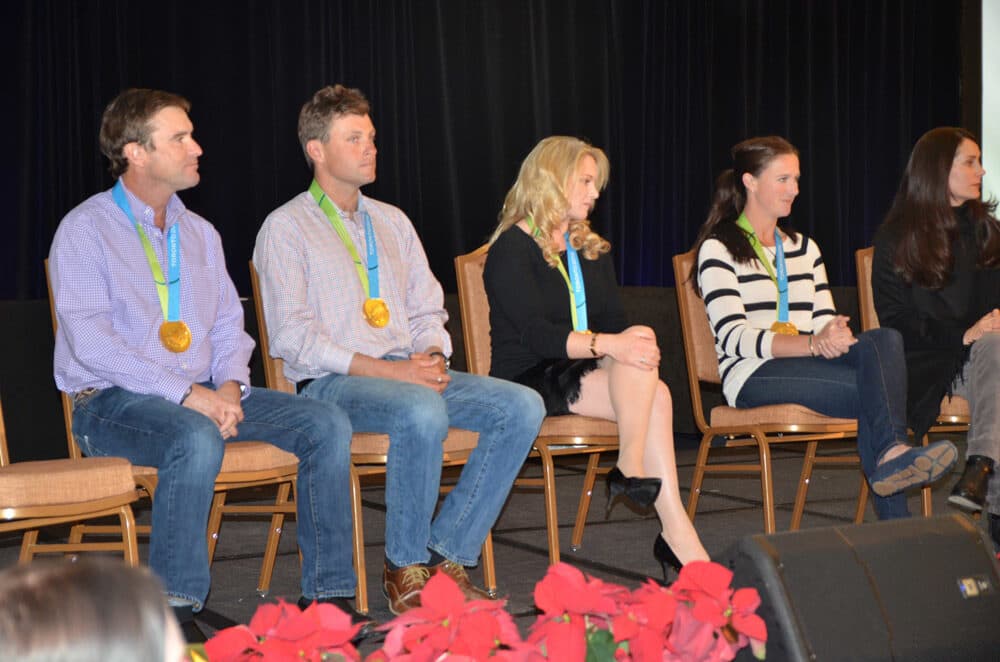
David O’Connor began this afternoon meeting by inviting the key players from the Pan American Games to reflect on their experiences and successes. This included USEF Managing Director of Eventing Joanie Morris, Team Veterinarian Dr. Susan Johns, and the gold medal team of Lauren Kieffer, Marilyn Little, Boyd Martin and Phillip Dutton. After introductions, Morris recognized the owners of the horses, grooms for the teams and the traveling reserve, Jennie Brannigan, for all of their support.
O’Connor then walked the audience through the experiences of the team in Toronto. He showed the audience a slideshow of the team’s winning weekend at the Pan American Games. These included “behind the scenes” photos, which gave attendants an inside view of the Event. O’Connor and the team shared many laughs on their experiences including coping with deafening techno music in the dressage warm up, which unsettled many horses including Boyd Martin's horse Pancho Villa. Team members then spoke on the responsibility and privilege of representing the United States. Phillip Dutton put it best by saying, “We don’t take lightly being put on a team.”
The presentation concluded with O’Connor’s discussion on the 2016 Olympics. The area where equestrian competition will take place is called Deodoro, and it is located on a military base. The U.S. Team will spend their final preparation days in Florida before leaving from Miami.O'Connor reports that the usual frequent rain in Florida during that time of the year will give the athletes the best footing possible. O’Connor is very familiar with the venue as this is the same location where he coached the Canadian team in the Pan American Games in 2007.
Rule Change Open Forum
Malcolm Hook lead the rule change open forum in the afternoon. Each year this forum allows members to state their opinions and concerns on potential rule changes. Hook takes these discussions over to the USEF Eventing Technical Committee, who take the discussions into consideration when approving or disapproving the proposals. Because of time constraints, this forum couldn’t address all Rule Changes, so click here for a complete list.
Rule Changes Discussed:
- EV App 1: This is a re-write to Appendix 1. It will return the wording to how it existed before 2000. This change in wording would limit how creative course designers could be, and concurs with previous suggestions that too many technical questions were being introduced at lower levels.
- EV App 3: Modified Division.
- Rewrite to appendix 1. Return it to the wording used before 2000, which limits how creative a course designer can be.
- Modified division as a new division to be an interim step between Training and Preliminary level. There would be no requirement by the organizer to offer this division.
- Many organizers discussed that these courses could be created by using a mixture of existing Training and Preliminary jumps that do not exceed 3’5”.
- You must have two qualifying scores at Training level and higher to compete in this division. Scores in this division can be used to qualify for a move up to the Preliminary level as well.
- EV 106.3 This standardizes that the opening date for an Event will be six weeks prior to the start of an Event.
- EV 115.2 Equine Footwear – This addresses equine riders with barefoot horses who would like to use protective footwear in dressage. The proposal included wording which involved fly bonnets, and because of that the Technical Committee decided to return the proposal unapproved with their request for that statement to be removed or reworded.
- EV 149.6/EV 149.7: At a Preliminary championship, there may be one vertical and one ascending oxer 5 cm higher than maximum height.
- EV 134.3 This rule change proposal means riders are no longer eliminated for leaving horse boots on in the dressage phase as well as carrying a whip where whips are illegal. Either of those offenses will now result in a two point penalty instead of an elimination.
- Another aspect of this means riders are not eliminated for entering the arena within 45 seconds after the bell. A rider then had an additional 45 seconds to make their way into the area and will receive penalties.
- EV 177.5 Farrier must be present on grounds during cross-country and show jumping for all competitions Preliminary and above. It is likely this will be amended to include all levels.
The group also discussed the new vaccination requirements of the USEF. These were put into place in order to standardize what can be required. It was not intended for every organizer to always ask for proof of these vaccinations. This was put into place to prevent discrepancy between venues. It is the responsibility of the organizer to announce that they will be asking for this poof of vaccination at some point before the Event.
The recently announce Beginner Novice – Assistance Allowed test division was also debated. Hook explained that “test” Events have existed for years and that it was the intention of the committee that this bring light to those options for organizers to get new competitors.
Volunteer Initiatives
Holly Covey, Bonnie Kibbie and Carol Kozlowski led an open forum on volunteer initiatives that was very well attended by organizers, volunteers and other interested parties. Covey and Kibbie had put together a presentation outlining incentives, education and development for Eventing volunteers. The goals of that the group are trying to achieve for the volunteers are:
- Volunteer database creation
- Online resources and volunteer education
- Incentives and volunteer recognition
The presentation outlined several ideas on how the goals will be accomplished, and they spoke about working from the top down and using the resources of the USEA to create the database and fund many of their ideas.
The volunteer database would be a confidential website which would be accessed only by volunteers and organizers and would allow there to be a “pool” of volunteers who are willing and able. It would also offer an avenue for feedback between organizers to volunteers and vice versa.
Other educational and online resources that would be more widely available would include: “volunteers wanted” classifieds, tracking of hours for potential year-end awards, educational videos and training and a volunteer forum for the sharing of ideas.
Ideas which the presentation outlined for volunteer recognition and incentives included the creation of a volunteer identification lanyard program based on a tiered system of experience, national recognition, merit-based awards and local incentives.
Following the presentation the room was opened up for comments and questions.
Eventing High Performance Riders
In the final Eventing High Performance session of the 2015 USEA Annual Meeting and Convention, David O’Connor handed the stage over to Marilyn Payne. Payne has been named as the President of the Ground Jury for the 2016 Olympics and she spoke on the “Methodology of Judging”. Following her presentation which focused on the training scale and the formula that judges use, Payne took the opportunity to go over the Olympic dressage test with the riders as this is her last time she is able to speak with them until after the Olympics.
A few interesting tidbits from Payne:
- When things go wrong don’t get upset, don’t slam to a halt or lose your cool – just keep riding the movements.
- Be very careful with double bridles (too much control is the worst thing you can do)
- Collection is a gathering of the energy – not something you get by using the reins, it is something you get by using your seat and legs.
- FEI dressage judges discuss at the end of the day any tests that were more than 5% off as judges education
- The horse should seek the contact and the rider should provide it (you can’t take more contact, you have to find ways to have the horse look for it). Michael Jung’s riding is a good example of proper contact.
- Positive and Negative Dissociation. Positive: Hind legs are going to hit a split second before the front legs. Negative: Front legs hit first.
- Judges formula: Basics + criteria +/- modifiers = score
Adult Riders Open Forum
The Adult Riders Open Forum gave all of the Area Adult Rider Chairs the opportunity to report back on each of the activities in their area. Most of the focus of the Programs across the country was on providing educational opportunities, Adult Rider Team Challenges, social events, growing and promoting membership and awards.
Related Articles
Risky Business
Every sport carries some risk, but equestrian activities involve working with animals that weigh over 1,000 pounds—and whose first instinct is often to flee first, ask questions later.