Finding Footwork for Young Event Horses
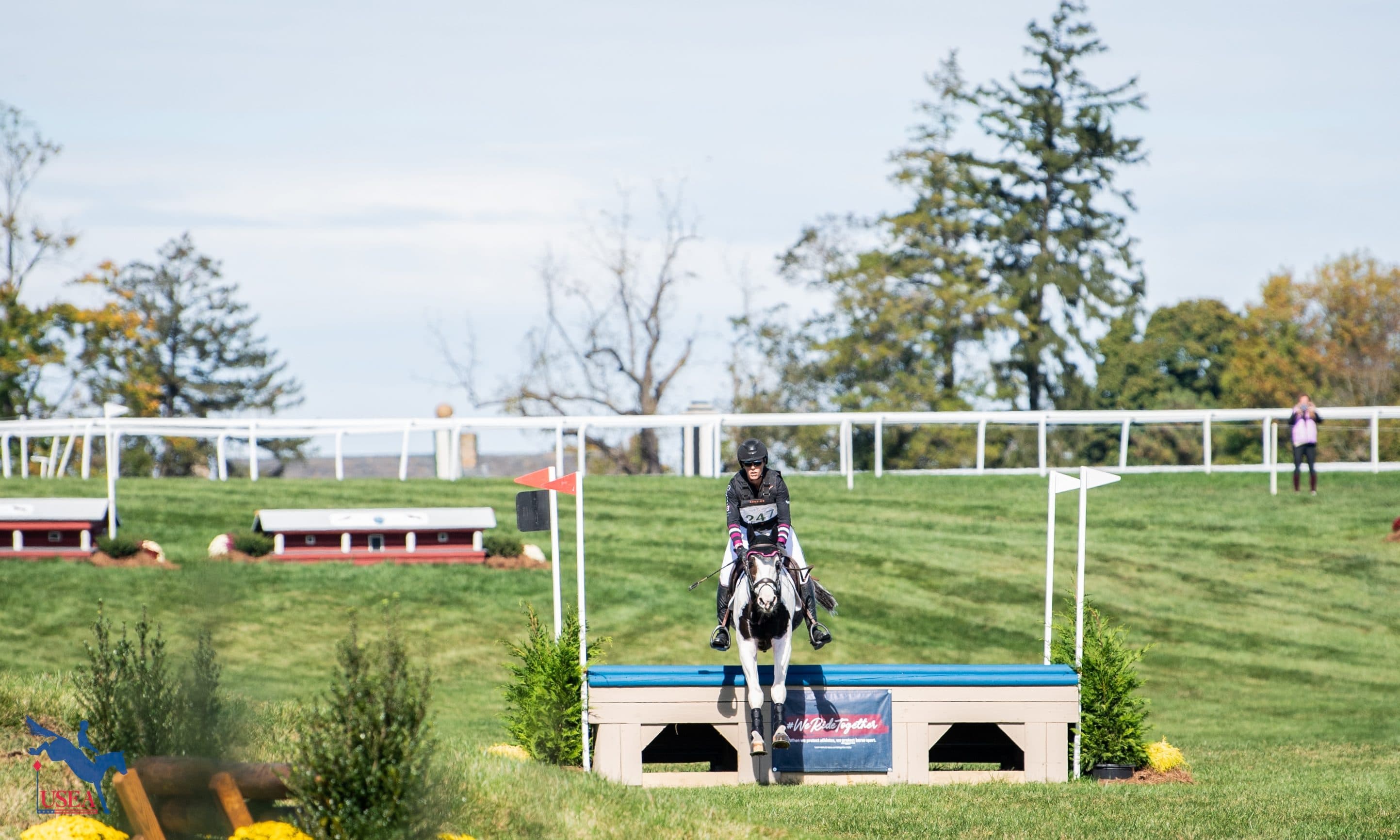
Learning footwork is a key concept when teaching a young horse to jump. Using grids in the arena over show jumps will set them up for success as they start to learn about cross-country questions like banks and ditches and will help them learn rhythm and relaxation.
Matt Flynn, a five-star rider and former member of the USEA Young Event Horse (YEH) Committee, operates Flynn Sport Horses in Ocala, Florida, where he specializes in working with young eventers and show jumpers.
“Event horses need to be quick thinking in our sport in general, so we're trying to produce quick thinkers,” he said. “I think as modern sport, and all disciplines, have evolved, we need quick thinkers in every modern horse.”
Flynn uses the following exercise for his young event horses as they prepare for the spring season. This exercise is appropriate for horses who’ve been in work and can be reduced in the number of elements depending on the horse’s experience level.
“I find it a useful exercise to educate the horses in stride control,” said Flynn. “A lot of what you're trying to do [with a green horse] is improve technique and have exercises that are strengthening and confidence building and help horses find a clever technique and introduce footwork. In general, with any young horses, regardless of discipline and jumping sport, those are the things that I would be after.”
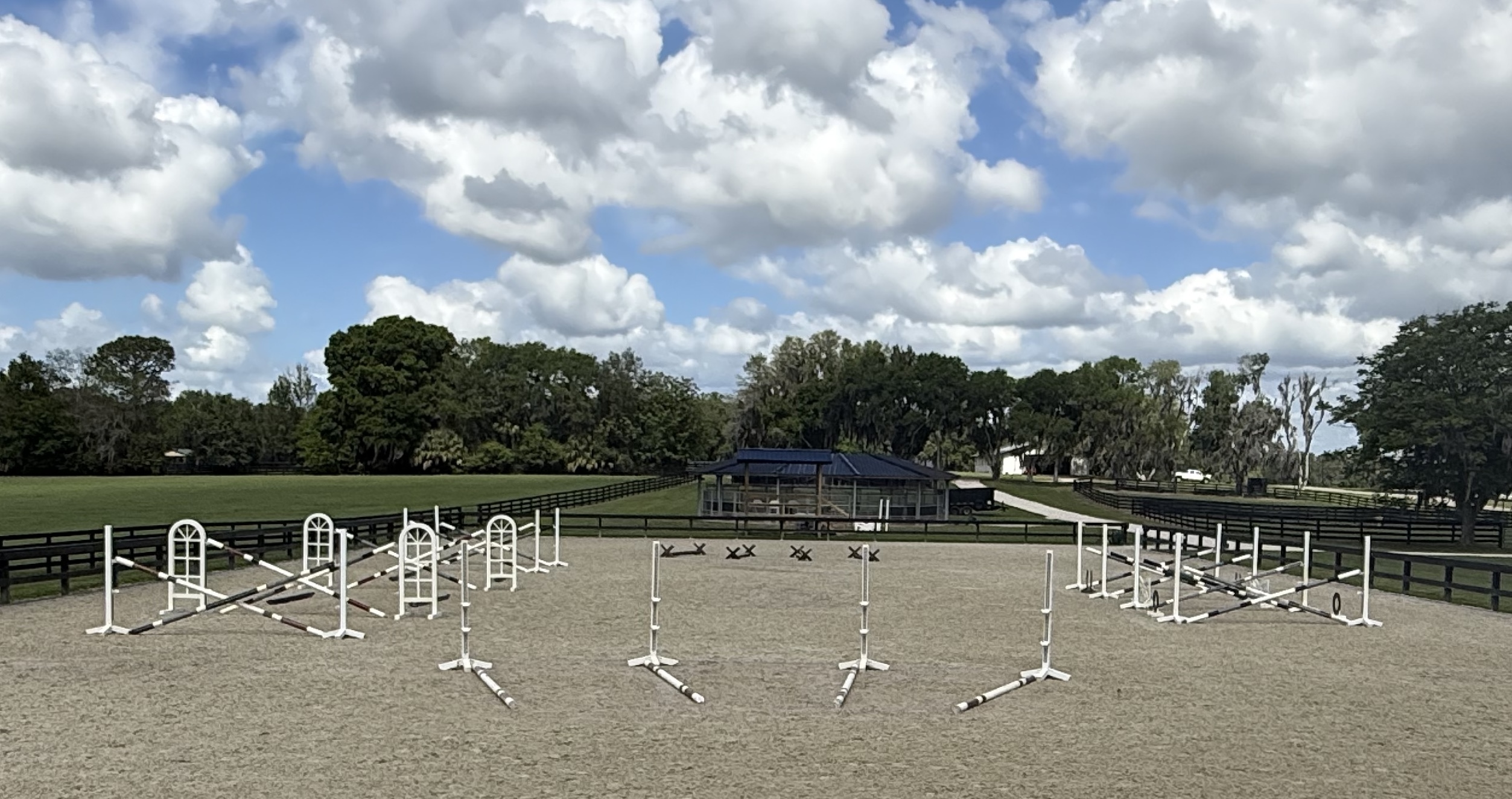
The line of jumps to the left of the photo are set as a single bounce set at 11’ to two one-strides set on 23’, then another single bounce at 11’ to be approached in canter. The bounces to the right of the photo are 11’ apart to be approached in canter. The poles on the ground in the foreground and background are about 4' apart on the inside of the curve and up to 12' on the outside of the curve. Flynn says that the bounce distances can be varied between 9’-12’ depending on your horse.
“There are various ways of introducing the exercise,” said Flynn. “The ground rails are a more tolerate piece of equipment for error. I could reduce the bounce exercise to a cross rail if a horse needed to jump a fence before seeing two fences together. Otherwise, my horses that were comfortable started with a bounce and then I build it out to be the four bounces.”
The exercise is symmetrical. Once you jump through the bounces or the one-stride line, then circle and go through the canter poles, then repeat.
“I want to have a consistent rhythm, and I want the whole day to feel symmetrical,” said Flynn. “I want it to feel the same coming out of the line of exercises as I did going in; I want the last bounce to feel the same as the first bounce, and by reversing direction, I've made it really transparent that it's all the same. I want the horses to feel that the bounce going into the exercise is as soft and feeling as the bounce exiting the one-stride exercise. I'm trying to build a horse even on both leads, so that if a horse is more right-handed than left-handed, I'm going to work to aim to create the same.”
About the USEA Young Event Horse (YEH) Program
The Young Event Horse (YEH) Program was first established in 2004 as an eventing talent search. Much like similar programs in Europe, the YEH program was designed to identify young horses aged four- and five-years-old, that possess the talent and disposition to, with proper training, excel at the uppermost levels of the sport. The ultimate goal of the program is to distinguish horses with the potential to compete at the four- and five-star levels, but many fine horses that excel at the lower levels are also showcased by the program.
The YEH program provides an opportunity for breeders and owners to exhibit the potential of their young horses while encouraging the breeding and development of top event horses for the future. The program rewards horses who are educated and prepared in a correct and progressive manner. At qualifying events, youngsters complete a dressage test and a jumping/galloping/general impression phase. At Championships, young horses are also evaluated on their conformation in addition to the dressage test and jumping/galloping/general impression phase. Click here to learn more about the Young Event Horse Program.
The USEA would like to thank Platinum Sponsor, The Dutta Corp., Gold Sponsor Goresbridge, as well as Contributing Sponsors ARMA, Bates Saddles, CrossCountry App, FLAIR Equine Nasal Strips, Gallagher's Water, HorseWeek, The Jockey Club, Kerrits, Marshall+Sterling, Schneiders Saddlery, SmartEquine, and Standlee, and Prize Sponsor 100xEquine for sponsoring the Young Event Horse Program. The USEA also thanks Ocala Horse Properties for their support of the 2026 USEA YEH Symposium.
Related Articles
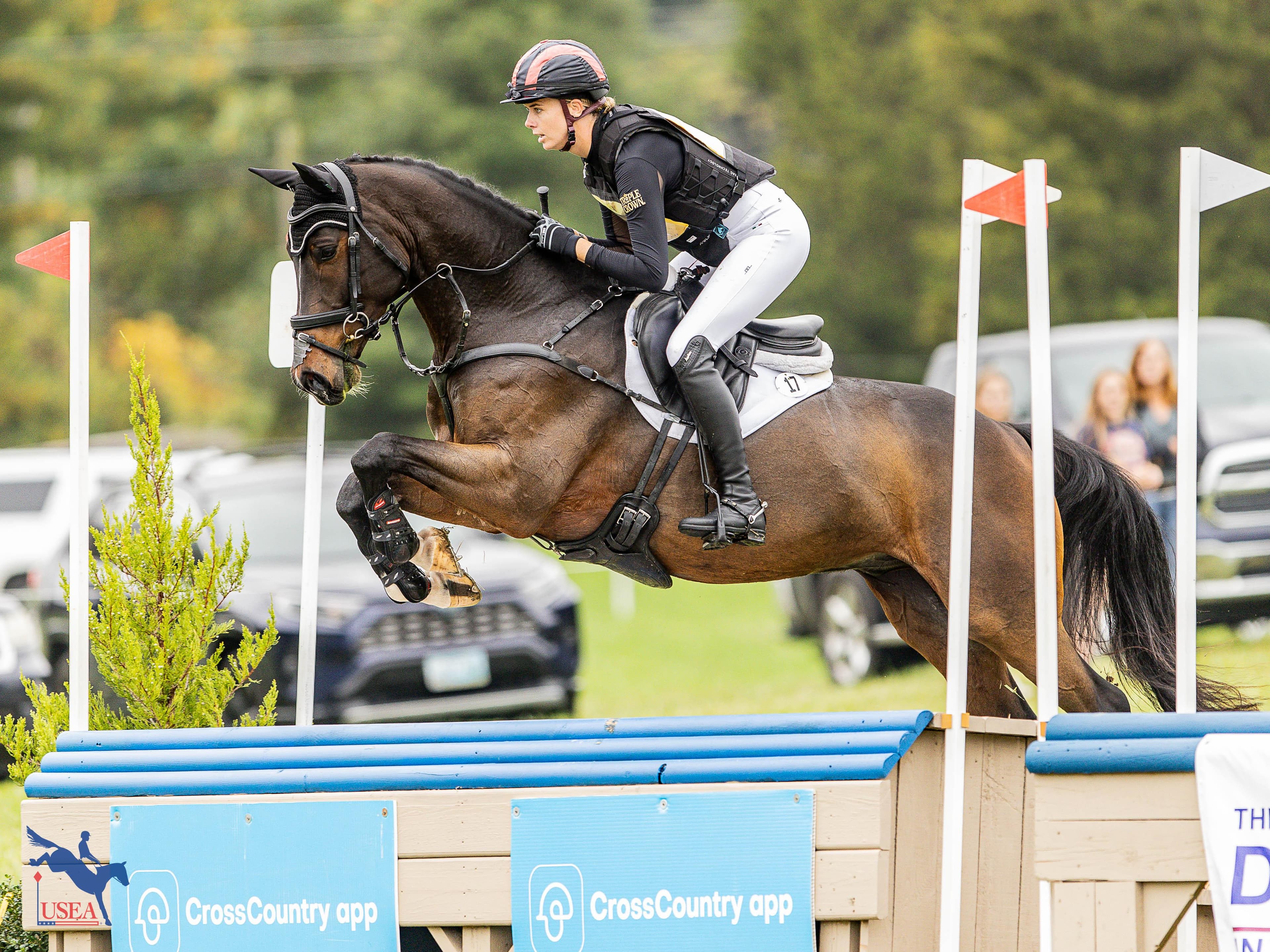
HSH Straight Arrow Hits the Mark in 2026 USEA Young Event Horse East Coast 4-Year-Old Championship
Caroline Pamukcu added another USEA Young Event Horse (YEH) Championship title to her résumé today at Fair Hill, piloting HSH Straight Arrow to victory in the 2026 USEA YEH East Coast 4-Year-Old Championship. The 4-year-old Irish Sport Horse gelding, owned by Pamukcu and Sherrie Martin and bred b...
A Plea From Your Friendly Social Media Manager: Please Stop Using AI on Your Sale Horse Photos
I get it. You want to sell your horse. You have a photo from a show photographer, but it's not quite what you envisioned. The horse looks fine, but not great. The background is the schooling ring. The lighting is flat. And there's this tool that can fix all of it in seconds.
Fast Facts: 2026 USEA Young Event Horse East Coast Championships
Sixty of the country's top young horses are headed to Elkton, Maryland, for the 2026 USEA Young Event Horse (YEH) East Coast Championships, held alongside the CCI3*-L at Fair Hill. The field in...