The VAP Series – Learn About Cross-Country Jump Judging
Last month, the United States Eventing Association, Inc. (USEA) announced an exciting new program to recognize the sports’ most dedicated volunteers, coined the Volunteer Achievement Program (VAP). The VAP was created by the USEA Volunteer Committee to recognize volunteers for their education, experience, responsibility, and commitment in different volunteer positions offered at USEA Recognized Events.
Now that the program is available nationwide through EventingVolunteers.com, the USEA will be sharing best practices for completing your badge in every role available through the VAP. Keep reading to learn what it takes to be an exceptional cross-country jump judge and stay tuned at USEventing.com throughout the year to learn more about the other roles offered through the program.
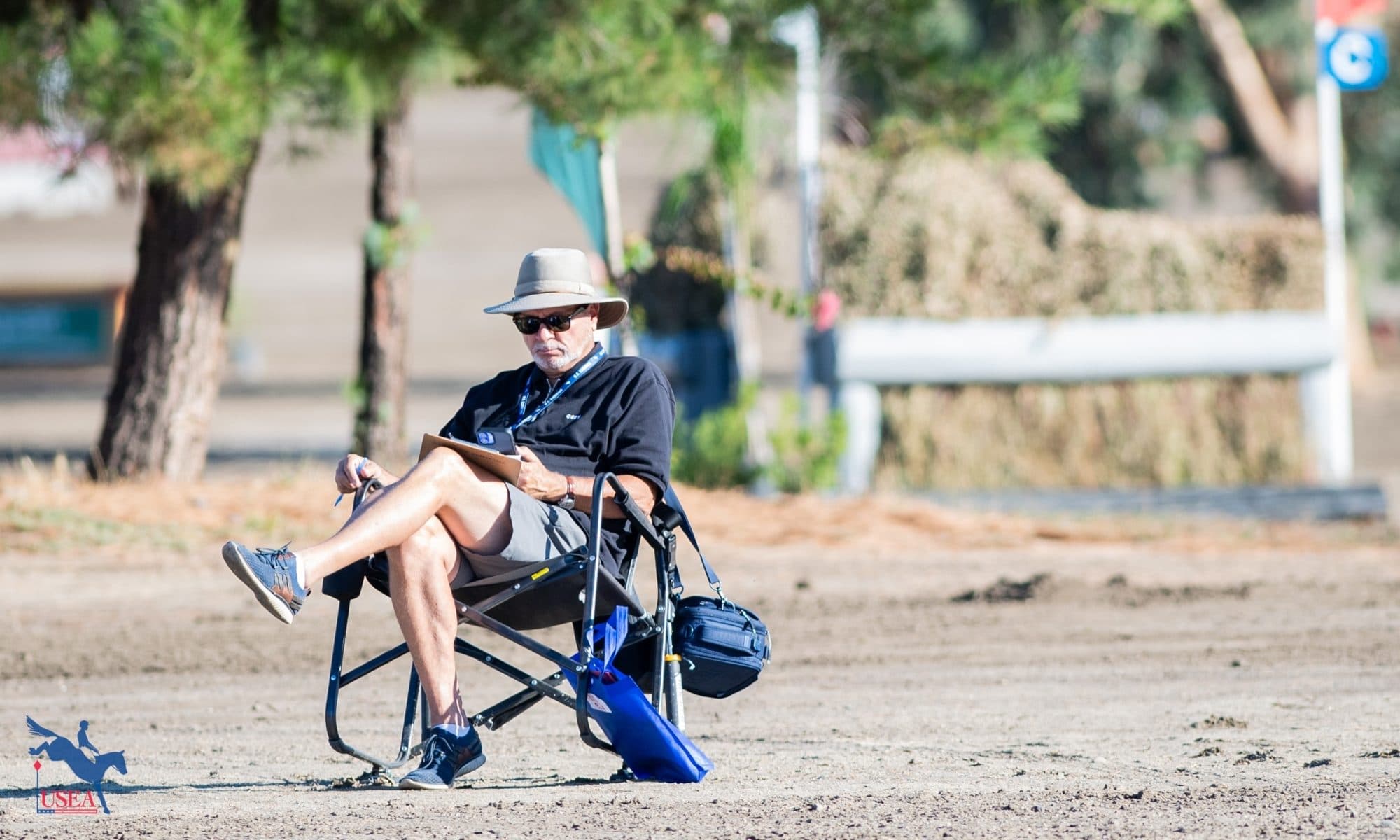
Cross-country jump judging may be one of the most popular and well-known volunteer roles in our sport. Getting a front row seat to the most exciting phase of competition may seem like all glitz and glamour, but serving as a cross-country jump judge requires a decisive, consistent volunteer to succeed.
What does a Cross-Country Jump Judge do?
There are two main responsibilities that are the hallmarks of jump judging: (1) maintaining a safe area around your jump, and (2) judging riders as they jump your jump. Here’s a breakdown of the activities you may be expected to handle in this role:
- Maintain a Safe Area:
- Keep a completely clear approach and landing to your jump for the competition; use your voice or whistle if needed to warn spectators or other competitors on foot of oncoming horses. This includes evaluating the footing at the jump and notifying control if repair is needed.
- Sit in front of and to the side of the jump to clearly see the horses as they approach; be out of the way but don’t hide. An official will check your positioning.
- If a horse is having difficulty at your jump, an oncoming rider has the right of way. Please inform the rider to clear the approach for the oncoming horse and rider.
- Report any instances of unauthorized assistance or cruelty (see guidelines for definitions of each).
- Promptly notify control in the case of a fall or accident. (Take your radio with you when you go to the rider).
- Judge Riders Jumping Your Fence:
- Observe each competitor at the jump, determine if any faults occur and record the appropriate penalties on your scoresheet.
- Know the wording and intent of the rules. Click here to review the USEF Rules for Eventing.
- Know that your jump is defined by a red flag on the right and a white flag on the left.
- Know the difference in judging an obstacle with a single number (i.e. 17) vs. one of multiple elements or parts (i.e., 17ABC)
- Do not discuss anything about the competition with competitors; if they have questions, politely refer them to one of the officials.
At every USEA recognized event, there will be a cross-country briefing prior to the start of competition. This briefing is mandatory, so be sure to arrive on time and listen carefully. Typically, the Cross-Country Controller and the Technical Delegate will speak at these briefings and provide important reminders about your role and any information that is specific to the event taking place. Utilize the officials for their expertise; if you have a question or are unsure about any part of your role, ask questions!
After the briefing, be sure to go out on the cross-country course and identify the jumps you’ve been assigned to judge. You will need to use a radio to communicate the events at your fence, and you will need to record each rider’s score on the scoresheets provided by the event staff. If there is more than one judge at your fence, it may be helpful to split these roles between you and your partner.
If you are a radio communicator, you will be instructed how to use your radio to report on the course by the Controller with any specific instructions during the briefing. Do NOT put the radio down if assisting a rider with a situation. You’ll be expected to immediately report three things—the status of the horse, the rider, and the jump. Your priority will be to notify control if medical assistance is needed for either the horse or the rider.
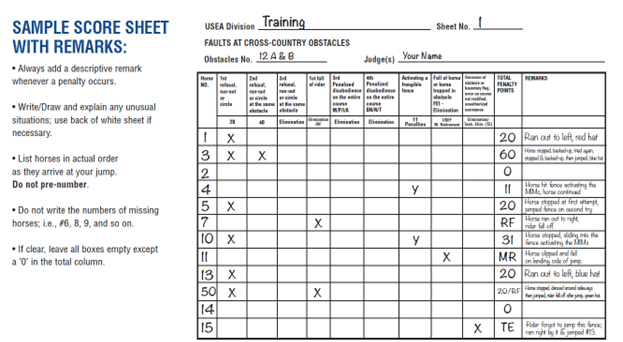
If you are recording scores, be sure that you understand how to properly fill out the jump judge scoresheet. You should memorize the common point values and acronyms for penalties and eliminations on course, but if you need a refresher, click here to review the role’s guidelines. A sample scoresheet is shown below as an example:
Why Should I Serve as a Cross-Country Jump Judge?
The top volunteers that served as cross-country jump judges each contributed 25+ hours to ensuring the safety of our riders on course last year. Hear from the experts on why they choose this role time and time again.
"I enjoy the immediate proximity to horses performing at speed and in balance, within open terrain rather than an arena. Jump judging allows me to be outdoors for extended periods while embedded in the rhythm of the course and experiencing the athletic partnership of horse and rider up close. It also allows me to help with horse and rider welfare. Jump judging offers sustained immersion in a sport I genuinely enjoy." - John P. (Area II)
"Being a cross-country jump judge is a super, fun volunteer job. You work with a team of judges & officials to ensure the safety of horse and rider. You use your radio to inform your team exactly what’s going on: did the horse & rider jump the obstacle(s) safety? Did they stop at your fence? Did they circle and incur a penalty? Has the rider fallen? Was a frangible fence activated? Do we need EMS or the Vet to come to the fence to help? Does the horse look too tired or have broken tack or is the horse bleeding from a cut along the way? We listen to each other on the radio, make sure all these things are reported and then document what’s happened on the scoresheet. Lots of things can happen, and I’m so very proud to be part of the team. Several of us volunteer often, and we have become good friends. It does not seem like work at all. At the end of each event, I feel so happy that our team has kept everyone safe. That’s why I keep coming back!" - Angie L. (Area II)
"Varied jumps with varied challenges. Each one is different, requiring different skills. All of them require the same basic skill set, but the different jumps make sure it’s not repetitive or boring, challenging me to improve my judging skill level. Depending where on I am on the course, I have the ability to see other parts of the course and follow the rider around and see how they respond at other jumps, which helps me if I'm at that jump in the future. I also get to see various riders and can follow them at different events up close and personal. I’ve seen riders that I would never have had the opportunity to see, and I follow lower-level riders as they progress in their development. Each day is different, never boring, and challenging." - Laurie H. (Area III)
How Do I Earn the Cross-Country Jump Judge VAP Badge?
Are you ready to earn your Cross-Country Jump Judge badge? Log onto EventingVolunteers.com, go to “My Dashboard,” and use the “My Achievements” tab to follow these steps to start your journey towards earning a badge today:
- View the volunteer video and read the guidelines for the role by clicking the icons next to the “XC Jump Judge” title in the first column.
- Take the assessment for the role and score a 80% or higher to proceed.
- Work as a jump judge at two (2) or more USEA recognized competition(s) for a total of ten (10) or more hours.
- Once the hour requirements have been met, apply for the badge directly through EventingVolunteers.com by requesting a recommendation in the fifth column on the “My Achievements” page.
- The Volunteer Coordinator(s) or Organizer(s) for each competition where you worked will be asked to approve your application for the badge.
- Once approved, the badge will be added to the role in your Eventing Volunteers profile.
To learn more about the Volunteer Achievement Program, click here. To create an Eventing Volunteers profile, click here. For more information on the VAP or the USEA Volunteer Incentive Program, please contact Kaleigh Collett at [email protected]. Good luck earning your next VAP badge!
About the USEA Volunteer Incentive Program
Volunteers are the lifeblood of our sport—the unsung heroes, and the people who make it possible to keep eventing alive. In efforts to recognize the dedication, commitment, and hard work that volunteers put into eventing, the USEA formed the Volunteer Incentive Program (VIP) in 2015. In 2017, an online management portal was designed for volunteers, organizers, and volunteer coordinators at EventingVolunteers.com, which is also available as an app for iOS and Android.
Volunteer incentives include national and area recognition, year-end awards, a top 10 USEA Volunteer leaderboard, and a Volunteer of the Year award which is given to the volunteer who accumulates the most volunteer hours on EventingVolunteers.com at recognized events throughout the USEA competition year. Click here to learn more about the USEA Volunteer Incentive Program.
The USEA would like to thank the Maryland International Educational Foundation and Horse Illustrated for their support of the Volunteer Incentive Program.
Related Articles

The Dutta Corporation Continues Support of USEA Young Event Horse Program in 2026
The United States Eventing Association (USEA) is pleased to welcome back The Dutta Corporation as a valued supporter of the USEA Young Event Horse (YEH) Program and the 2026 USEA Young Event Horse Championships. The Dutta Corporation will return...
A First FEI Win for MHE Excel Star Noble Ikon and Morgan Houberg in USEA/USEF 6-Year-Old Developing Horse National Championship
Heavy rain overnight and into the morning turned the final day of the 2026 USEA/USEF Developing Horse Eventing National Championships into a true test of the young horses' confidence, athleticism, and determination at Morven Park International. When the final scores were tallied in the CCI2*YH-S ...
Orpheus Rises to the Top to Claim USEA/USEF 7-Year-Old Developing Horse National Championship
Consistency across all three phases proved to be the winning formula for the Dutch Warmblood gelding Orpheus, who rose from third place after dressage to claim the 2026 USEA/USEF 7-Year-Old Developing Horse Eventing National Championship at Morven Park International on Saturday. Owned by Cellar F...