Ride Between the Flags with Kelli Temple: A Preliminary Level Bending Line
In this series, the pros walk through their approach to riding questions, fences and combinations on cross-country.
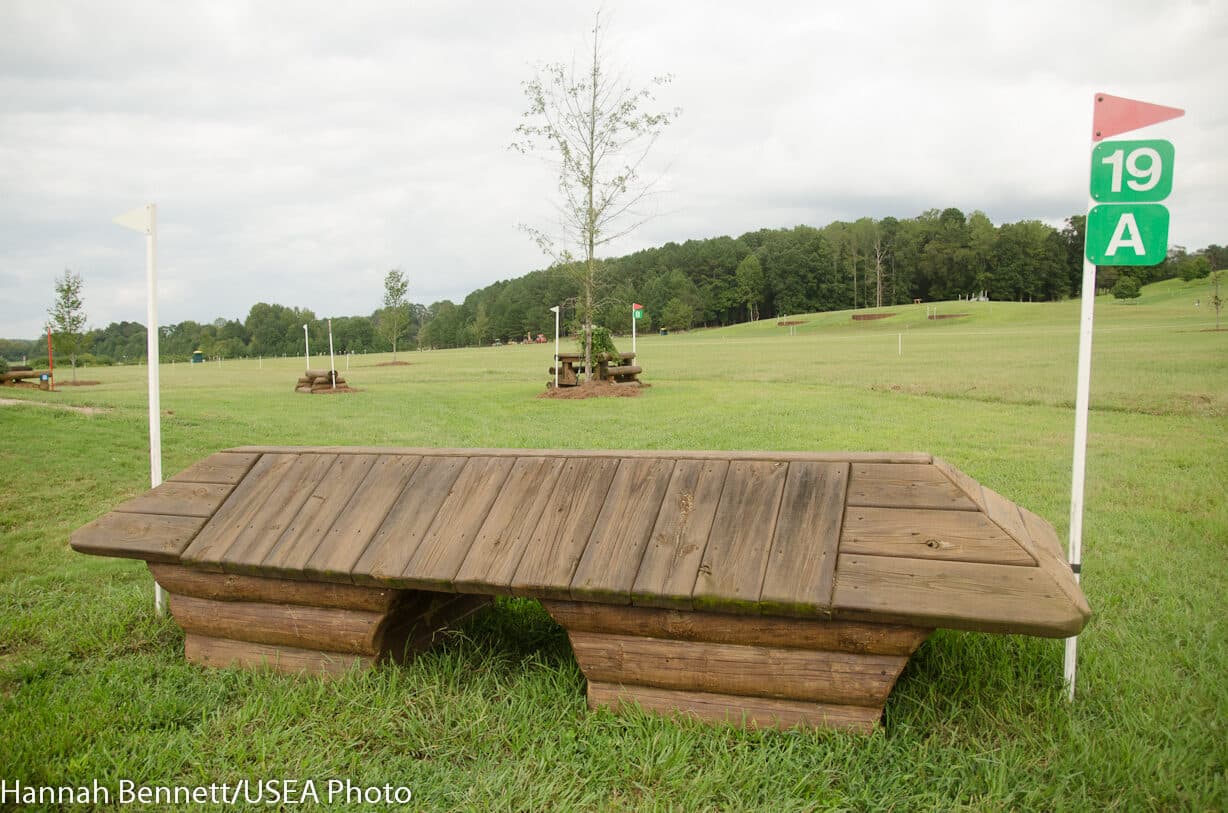
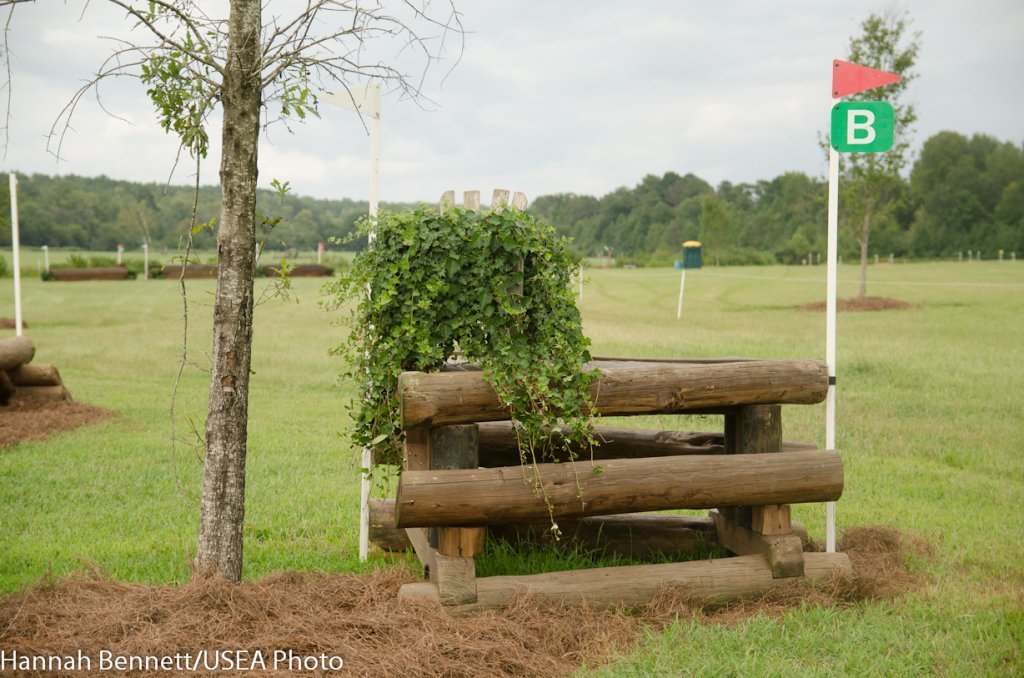
This is a bending line with an accuracy question. The first element is a table and the second element is a corner that requires the horse to jump it within a relatively narrow area.
When approaching any kind of combination, you need to think about your speed and balance. This question asks you to bring the horse’s canter speed back from your cross-country gallop to a canter that will allow you to make an accurate turn to the second element. We would call this canter needed a “show-jumping” canter. That describes a speed comparable to the same canter you would use in show-jumping (about 350-450 mpm). In addition, you would need to shorten the stride, and the balance would go from your ground covering gallop (that many times is on the forehand) to a more “uphill” and engaged canter that still has plenty of impulsion. To do this you would need to ride a series of half-halts to balance the horse, shifting the weight from the forehand to the hindquarters. Your position goes from balancing over the wither (where the center of gravity is in the gallop) to bringing your shoulders back, seat closer to the saddle, leg on and a solid contact to ride the half-halt.
Getting a good jump at the first element of this combination will help to ensure success in negotiating the corner. The first element of this combination is a small table. Because the table has a bit of width it is important to give the horse enough impulsion to clear the width without “standing off” of the jump and landing out of balance. The objective would be to find a medium, deep distance to the first element and land in the same “show-jump” balance that you had in the approach to the jump. That way the horse does not land pulling or on his forehand, making it difficult for you to rebalance him and to get his eye on the second element.
In a perfect world you would like to jump a corner on a line that is perpendicular to the line that bisects the corner. Course designers have started challenging riders with more and more oblique angles to corners which invite horses to run out. The single most important thing you need to do as a rider is make sure your horse can see where he is going to jump. You need to get his eye on it early so that he can prepare himself for the jump. On most corners, there is a flag on one side and usually some sort of object on the wide side of the corner so the horse sees that he is going to jump in between the two and does not make the mistake of jumping onto the widest section. If you land in a good balance from the first element, your horse will be in between your two legs and two hands making your job getting his eye on that area of the corner where he is going to jump that much easier.
Your success will depend partly on schooling this question often enough at home so that this is not a new concept to you or your horse, and then following a good bending line so that your horse’s eye is pointed in the direction he is going. Do not underestimate the importance of practice! Do not got through the turn with your horse’s head bent to the outside and at the last minute turn him to the fence. You will have a disaster!
Lastly, think about what type of fences have come before this combination on the course to prepare you and your horse for this particular question. If this is the first combination and you have been trundling along over four or five galloping fences, you might have to take a little more time to get your horse back for this one. If it is late in the course your horse might be more adjustable and you won’t need to take as much time. If, God forbid, you have a run out at the corner, take a minute to think about why it happened before you reapproach. If you were too fast and your horse was unfocused, take some time, put him a little more together and give him a good approach to help him figure out where he is jumping. If you rode too quietly and lacked enough impulsion or were pulling back in the approach then get him more energized and make sure you have your leg on for the second attempt. Either way since it is an A/B combination you cannot make a circle in between the two elements the first time you attempt it without a penalty. If you have a run out at the B element you don’t need to jump the A element again.
Kelli Temple is an Olympic-level rider with a focus on finding and developing young horses for the sport of Eventing. She has developed numerous horses to the Advanced level and has competed in the Olympics, World Games, European Championships and three- and four-stars around the world with horses she brought along herself. She runs her business out of her own Wyndemere Farm in Round Hill, Va.
Related Articles
USEA Podcast #412: The Stories that Defined Kentucky
Fresh off of the heels of a U.S. win at the Defender Kentucky Three-Day Event, the crew sits down to recap the weekend in the bluegrass and all the pairs that impressed during the CCI4*-S and CCI5*-L competitions. From well-deserved wins, to horses who won our hearts, to a moment that USEA CEO Ro...
The Countdown to the 2026 USEA American Eventing Championships presented by Nutrena Feeds is On!
The 2026 United States Eventing Association (USEA) American Eventing Championships (AEC) presented by Nutrena Feeds is headed back to the Kentucky H...