Finding and Fostering Talent in Young Horses at the 2026 Ocala Horse Properties USEA YEH Symposium
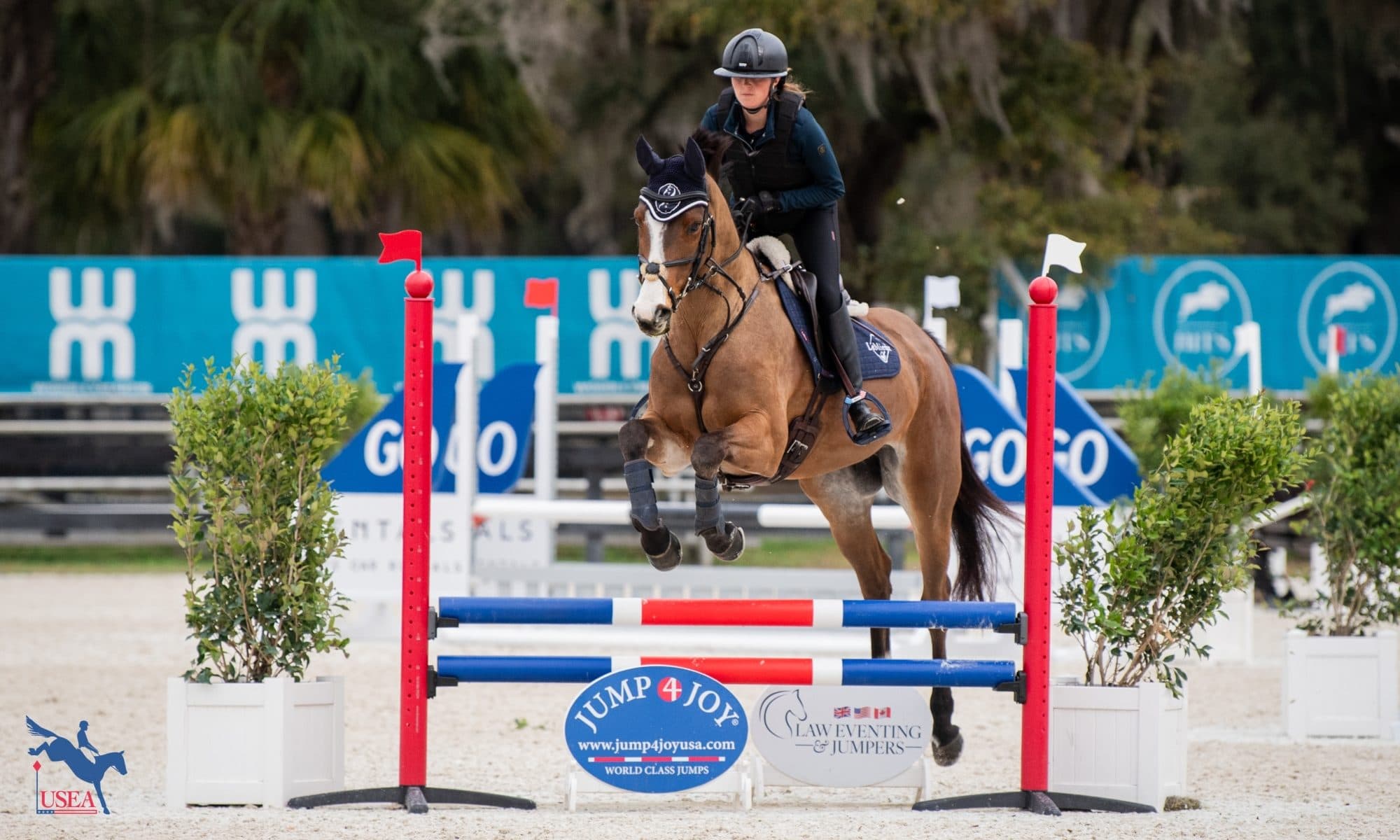
HITS Ocala played host to the evening session of the 2026 Ocala Horse Properties USEA Young Event Horse (YEH) Symposium on Feb. 16.
Five-star Canadian rider Lesley Grant-Law introduced the four demo riders to over 160 attendees and discussed the importance of taking time and care in developing a young horse.
“With my own human child, I want to ensure he’s a likeable human being, and I need to make sure he’s capable of being loved by somebody. And then lastly, I need to make sure he has value—that he is heavily employable. If he has those three qualities, I can leave here tomorrow and not have to worry about his future,” she said with a smile. “It is all of our responsibilities when we get involved with horses to make sure that they have the best start possible. Even the most ordinary ones can become extraordinary for somebody if they’re started correctly.”
Focus on the Flatwork
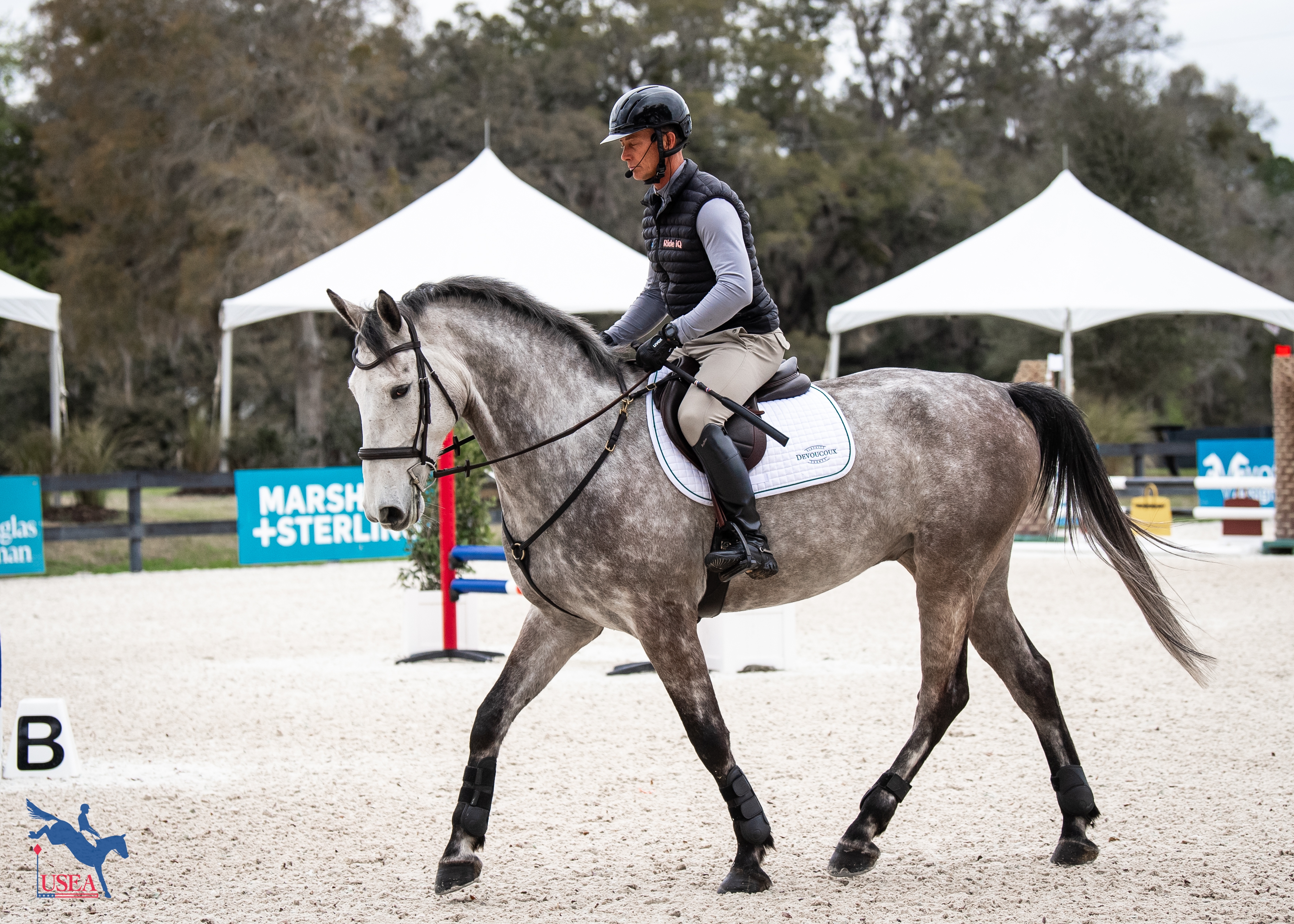
FEI five-star dressage judge Peter Gray started the session discussing some fundamentals of flatwork for young horses. Five-star riders Jonathan Holling and Leslie Law rode two young horses, warming up in front of the crowd in the VIP tent and getting them used to the bigger environment.
Holling rode Christina Ellison and Luann Ellison’s DHF Darwin, a 5-year-old Irish Sport Horse gelding (Hos D’O x DHF Take Off), and Leslie rode Stephen Brown’s Lankom AMG, 5-year-old warmblood gelding (Eldorado van de Zeshoek x Irene D Ecaussines).
They both warmed up in walk, alternating from free walk to medium walk and adding in leg yields and bending to help get them focused. Gray noted the first two parts of the German Training Scale, rhythm and relaxation, were key.
He called suppling and bending “horse yoga,” and noted that most high-level athletes have a warmup routine that involves stretching and bending their bodies.
Leg yielding in a variety of ways helps with the suppling and bending, and what you do at home might not be the version you’d use in competition. “One of my favorite exercises in training is leg yielding,” he said. “There's different kinds of leg yielding. We can spiral on a circle. We can go across the diagonal with some bending in the opposite direction. We would call this a training leg yield. We also have an opportunity at the end of the leg yield to add some bigger and slower or bigger strides and shorter strides—changing tempo within the gaits.
“In competition, we have a little bit of flexion in the poll and not neck bending, and the position can be a little bit more parallel. In USEF rules, the front end of the horse is the first to meet the track,” he added.
Stretching in trot is a good exercise for any horse, but especially young horses as it builds muscling over the back and can help them relax in a scary environment.
“It's very difficult for a horse to physically stretch down and forward if the vessel fibers behind the saddle and the top line are tight and uncomfortable,” he said. “The ability to stretch down is telling me that the horse is starting to get loose, to get relaxed, and as we add transitions and lateral work, we're then going to be able to address the hind leg and get it more active and get it more engaged.”
Overall, Gray wants to see young horses ridden in an encouraging way. Consider using a jumping saddle to do your flatwork, rise the trot, and try to use a forward seat as they develop their muscling. Always encourage the back to be loose.
A soft, confident contact with a following hand creates a positive and confidence building feel. Use short intervals of a quality canter, then bring them back to trot before they lose the balance and use lots of transitions between the gaits.
Once Holling got the relaxation he wanted with his horse, he stopped to address the audience.
“Every time he hears anything coming from you guys, he gets nervous and worried about it, so I think my goal in the ride is trying to [help him] relax and understand that this is a happy place to be, so that when he goes to the next pressure situation, that he understands that nothing bad is going to happen, and that he can just sort of take the time and be patient,” he said. “It's really more important to me to try to work on his relaxation than worry about how engaged is he? What's his frame? How perfect can I make me look? And instead, I try to focus on what I'm feeling underneath me, and is he a horse that's going to be enjoyable to ride?”
Evaluating Jumping Potential
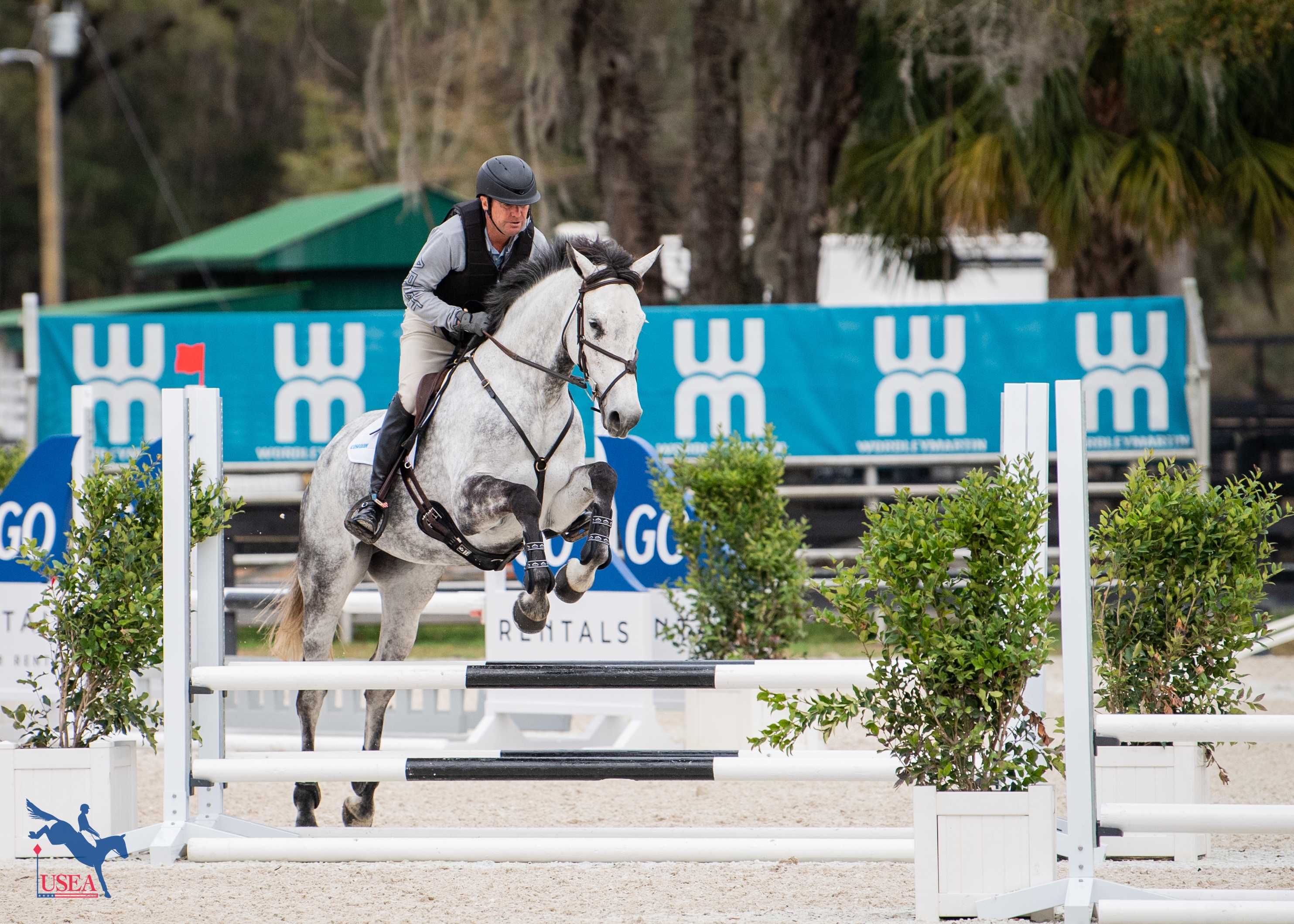
Olympian Phillip Dutton and his daughter, Olivia Dutton, rode two young horses over show jumps and portable cross-country obstacles provided by sponsor Jump4Joy USA. Phillip rode Michael French’s Flagmount’s Irish Grace, a Irish Sport Horse/Hanoverian mare (Flagmount's Freedom x Falconwood’s Ice Machine), and Olivia rode Kendra Heath-Brost’s Rathfredagh Chazz, a 6-year-old Irish Sport Horse gelding (Timone x Corline Z).
They focused on balance, direction, rider position, softness, rhythm, and speed as they worked over single fences and created courses including angled combinations, skinnies, and a corner.
The key on cross-country is to have a horse who will hold on the jump, said Phillip. Teaching them to get close to a fence will help them understand how. “If you’re coming down to a jump, and you soften, the horse is going to pat the ground and hold on the jump. Particularly if you have a strong horse, you don’t want to have to hold them to the jump.”
During a Q&A session after the jumping demonstration, the riders discussed how the evaluate a young horse’s potential.
When looking at a young horse for any job, the Laws both agreed that they prefer to see the horse in person and rarely buy off videos.
“There's only so much you could do with a 4-year-old, but it's all about the feel,” said Lesley. “Leslie’s horse, it's dangling its legs sometimes, or Phillip’s with its [busy] mouth, or Olivia's jumps in a funny shape. You can't judge a 4-year-old by what you see on the day all the time. But you know what? You could sure feel it. I've gotten on a horse and been like, ‘I'm buying this no matter what,’ and I bought it even if it doesn't have the best vetting because I can feel that this is an out and out athlete. And so far, I haven't been wrong.”
Phillip agreed that the feel of the horse is important and recommended bringing an expert with you if you don’t have much experience picking out a young horse.
“It's a little bit of a crapshoot, because just like us, they mature differently and grow differently,” he said. “If you have some experience, you can feel the scope in the jump. A horse that is jumping, even if they just started to jump, if they do it easily and just have a nice, slow jump and don't rush it and be flat and use their whole body. It's very hard to pick it out and be guaranteed. But when I'm buying a horse, I like to have an idea that if it doesn't work for me, if it can work for somebody else. A very talented horse, but a really difficult one is always going to be hard to sell if it's not going to be that suitable for anybody else. If It doesn't work out for you, have an idea what another another life would look like for that horse as well.”
Holling agreed that scope is important, but he likes to see instinctual footwork over fences, and he always pays attention to how the horse interacts with people on the ground. “I pay attention to what they're like in the barn, because I think it is difficult to know what a 4-year-old in the cold in a ring that maybe has three jumps in it [will be like.] But the way that they react around people, the way they behave in the stable, that can give you a lot of insight as to what the personality of that horse is.”
About the USEA Young Event Horse (YEH) Program
The Young Event Horse (YEH) Program was first established in 2004 as an eventing talent search. Much like similar programs in Europe, the YEH program was designed to identify young horses aged four- and five-years-old, that possess the talent and disposition to, with proper training, excel at the uppermost levels of the sport. The ultimate goal of the program is to distinguish horses with the potential to compete at the four- and five-star levels, but many fine horses that excel at the lower levels are also showcased by the program.
The YEH program provides an opportunity for breeders and owners to exhibit the potential of their young horses while encouraging the breeding and development of top event horses for the future. The program rewards horses who are educated and prepared in a correct and progressive manner. At qualifying events, youngsters complete a dressage test and a jumping/galloping/general impression phase. At Championships, young horses are also evaluated on their conformation in addition to the dressage test and jumping/galloping/general impression phase. Click here to learn more about the Young Event Horse Program.
The USEA would like to thank Platinum Sponsor, The Dutta Corp., Gold Sponsor Goresbridge, as well as Contributing Sponsors ARMA, Bates Saddles, CrossCountry App, FLAIR Equine Nasal Strips, Gallagher's Water, HorseWeek, The Jockey Club, Kerrits, Marshall+Sterling, Schneiders Saddlery, SmartEquine, and Standlee, and Prize Sponsor 100xEquine for sponsoring the Young Event Horse Program. The USEA also thanks Ocala Horse Properties and Jump 4 Joy for their support of the 2026 USEA YEH Symposium.
Related Articles
A Plea From Your Friendly Social Media Manager: Please Stop Using AI on Your Sale Horse Photos
I get it. You want to sell your horse. You have a photo from a show photographer, but it's not quite what you envisioned. The horse looks fine, but not great. The background is the schooling ring. The lighting is flat. And there's this tool that can fix all of it in seconds.
Fast Facts: 2026 USEA Young Event Horse East Coast Championships
Sixty of the country's top young horses are headed to Elkton, Maryland, for the 2026 USEA Young Event Horse (YEH) East Coast Championships, held alongside the CCI3*-L at Fair Hill. The field in...
Derek di Grazia to be Inducted into U.S. Eventing Hall of Fame in December at the USEA Annual Meeting & Convention
Since 1999, more than 50 outstanding horses and people have been inducted into the U.S. Eventing Hall of Fame. Induction into the Hall of Fame is the highest honor awarded within the sport of eventing in the United States that is only bestowed to individuals who have made significant contribution...