Understanding Air Quality Decisions at US Equestrian-Licensed Competitions
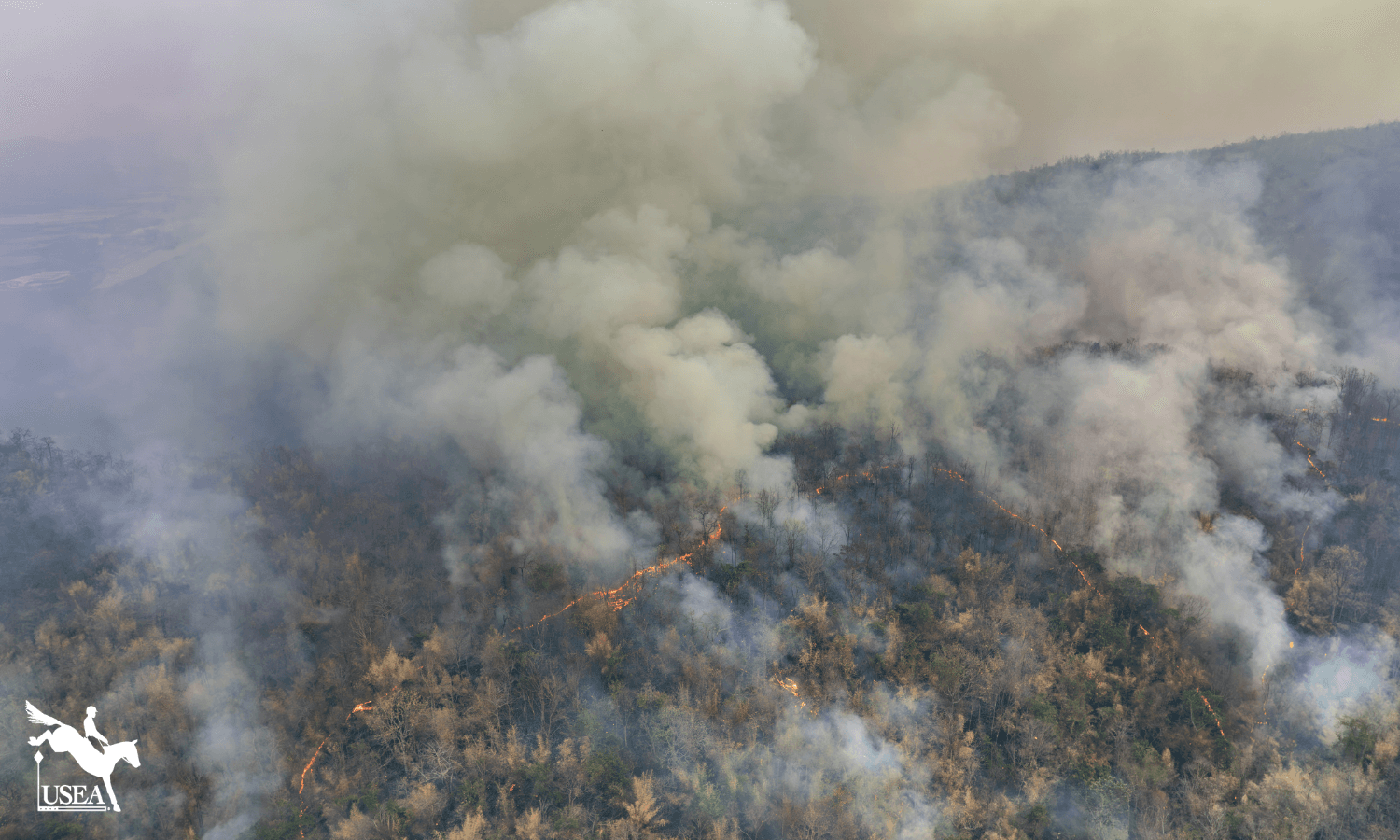
As wildfire smoke and other environmental conditions continue to impact air quality in parts of the country, competitors may find themselves wondering how decisions are made regarding whether an equestrian competition proceeds as scheduled, is modified, or is canceled.
The following guidance is based on recommendations established by US Equestrian, the national governing body for equestrian sport in the United States. While the United States Eventing Association (USEA) shares this information to help educate its members, these air quality recommendations and competition guidelines are developed and maintained by US Equestrian.
The health and welfare of both horses and people remain the highest priority. US Equestrian has established these guidelines to help competition organizers monitor changing conditions and make informed decisions when air quality becomes a concern.
What Is the Air Quality Index?
The Air Quality Index (AQI) is a tool used to measure air quality on a scale from 0 to 500. The index is based on five major air pollutants:
- Ground-level ozone
- Carbon monoxide
- Sulfur dioxide
- Nitrogen dioxide
- Airborne particulate matter (fine particles commonly associated with wildfire smoke)
In general, the higher the AQI, the greater the concentration of pollutants in the air. An AQI of 50 or below is considered good air quality, while readings above 300 are considered hazardous.
Although the AQI was developed for human health, USEF currently uses these same ranges as a guide for equine welfare until additional horse-specific research becomes available. An AQI above 150 is considered unhealthy for humans, and exercising horses is not recommended.
Competitors can monitor current conditions at AirNow.gov and other local air quality resources before traveling to or competing at an event.
How Poor Air Quality Affects Horses
Smoke and airborne pollutants can irritate a horse's respiratory system, potentially causing:
- Coughing
- Nasal discharge
- Increased respiratory effort
- Respiratory inflammation
- Reduced athletic performance
Even healthy horses may be affected during periods of poor air quality, and horses with existing respiratory conditions may be at even greater risk.
How Competition Decisions Are Made
There is rarely a single factor that determines whether an event continues as planned. Competition organizers continuously monitor changing conditions for their location and evaluate multiple sources of information throughout the day.
In addition to tracking AQI readings, organizers may consider:
- Local weather forecasts and smoke projections
- On-site conditions
- Guidance from state and local health agencies
- Emergency management recommendations
- Venue-specific factors and the welfare of horses and participants
When conditions warrant, organizers may modify schedules by delaying start times, shortening competition sessions, adjusting warm-up schedules, or adding breaks to take advantage of periods with improved air quality. Organizers should have a clear process for withdrawals, refunds, credits, or schedule changes and utilize multiple communication channels to alert participants of any changes.
USEF strongly recommends suspending or canceling competitions if the Air Quality Index exceeds 150.
Competitors Should Make Individual Decisions
While organizers work to provide the safest possible competition environment, each rider is ultimately responsible for determining whether conditions are appropriate for themselves and their horse.
Factors such as a horse's age, fitness level, respiratory health, recent travel, and previous exposure to smoke may all influence whether competing is the best decision. Anyone with underlying medical conditions, or whose horse has underlying medical conditions should consider individually whether to compete when the AQI is in the orange zone of 101 to 150.
Competitors are encouraged to:
- Monitor AQI conditions before and during competition.
- Stay informed through official event communications.
- Consult with their veterinarian if they have concerns about their horse's health.
- Provide frequent access to clean water and keep horses in shaded, cooler, and lower-dust areas when possible.
- Be prepared for schedule adjustments if conditions change throughout the day.
- Not compete if you or your horse shows signs of respiratory distress.
Staying Informed
Air quality can change rapidly, particularly during wildfire events. Competitors should monitor trusted resources such as AirNow.gov, local weather forecasts, and official communications from competition organizers before and during an event.
For additional information about equine environmental health, visit the USEF Equine Environmental Health resources at usef.org/learn/equine-health/equine-environment. Questions regarding specific situations may be directed to [email protected].
Related Articles
Derek di Grazia to be Inducted into U.S. Eventing Hall of Fame in December at the USEA Annual Meeting & Convention
Since 1999, more than 50 outstanding horses and people have been inducted into the U.S. Eventing Hall of Fame. Induction into the Hall of Fame is the highest honor awarded within the sport of eventing in the United States that is only bestowed to individuals who have made significant contribution...
Never Say Never: Devoted Area VII Volunteer Sarah Airhart Completes Her First USEA Recognized Event
Sarah Airhart had it made. She was enjoying a half lease on a 16.2 Warmblood named Pantero (Rex Grannus x Tibet) that she adored and whose owner, Ronni McLaughlin-Remy, was willing to take them wherever they’d liked. She also landed a coach who she long admired through her 12 years of volunteerin...
The Work of Breathing: Respiratory Load and the Young Event Horse
Developing a young event horse is an exercise in patience and detail. Riders build fitness gradually, introduce new questions carefully, and pay close attention to soundness, nutrition, and confidence. One part of the workload is easy to overlook because it rarely shows itself: the work of breath...