The VAP Series: Cross-Country Starter
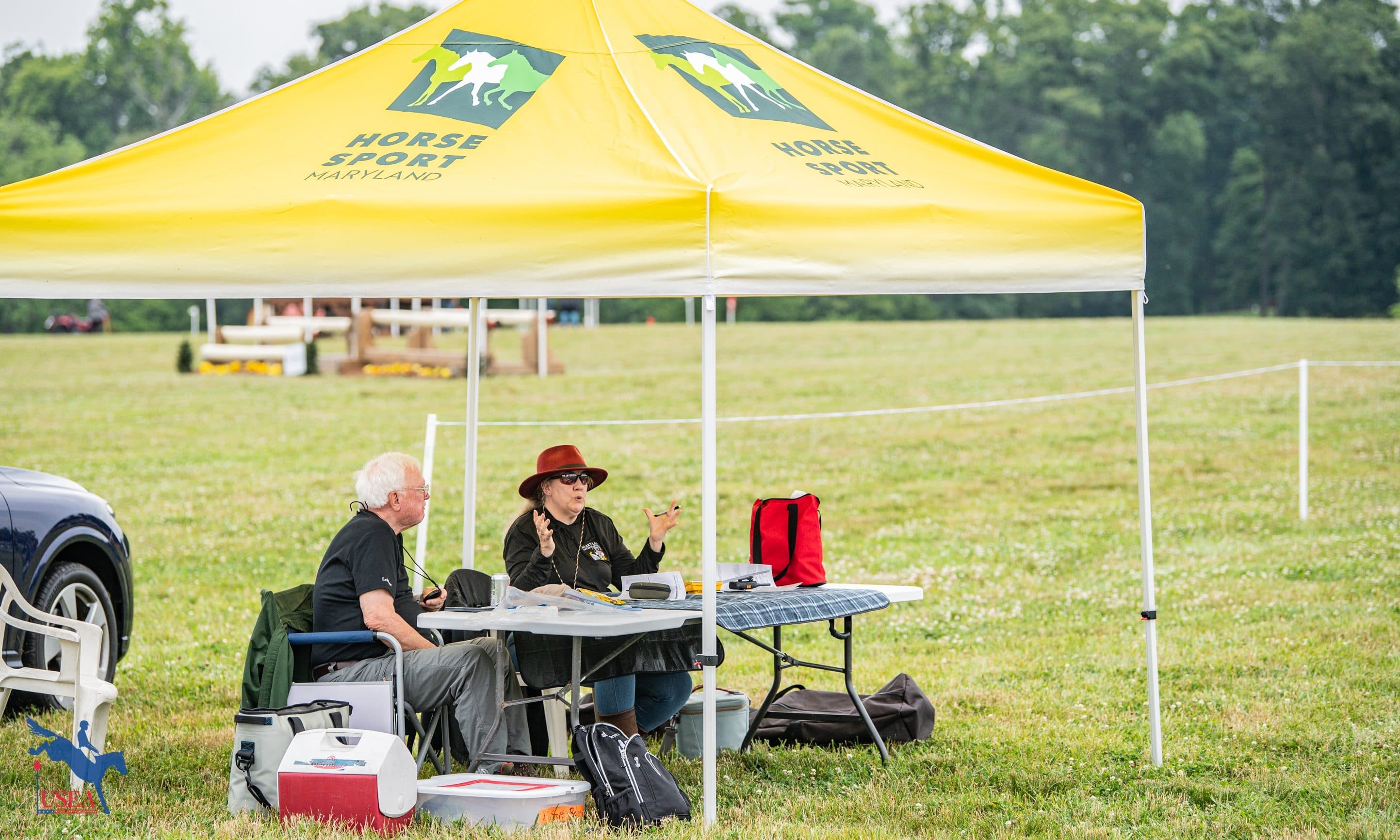
There are few places at an event quite like the cross-country start box. Excitement, nerves, anticipation, and adrenaline all meet in one small space, and the cross-country starter is there to make sure each competitor begins their round accurately, safely, and with confidence.
The USEA Volunteer Achievement Program (VAP) was created by the USEA Volunteer Committee to recognize volunteers for their education, experience, responsibility, and commitment in different roles offered at USEA Recognized Events. Next up in our VAP Series, which shares best practices for completing your badge in every role available through the program, we will be highlighting the role of cross-country starter.
Stationed at the beginning of the cross-country course, the starter is responsible for sending each competitor out at their scheduled time. But the role is about much more than counting down the seconds. A good starter must stay organized, communicate with officials and fellow volunteers, keep a close eye on the schedule, and often provide the final friendly face a competitor sees before galloping away from the start box.
What Does the Cross-Country Starter Do?
The primary responsibility of the cross-country starter is to start each competitor on course at their scheduled starting time and accurately record when they leave the box.
Before cross-country begins, starters check in and collect the materials they will need for the day, which may include an order-of-go, timing sheets, timing device, radio, clipboard, and pens or pencils. Once at the start box, they organize their station, make sure they know how to operate the timing equipment, and review the order-of-go for important details such as competitors riding multiple horses or missing numbers.
Communication is an important part of getting ready. The starter should coordinate with the cross-country warm-up steward about how riders will be sent to the box and communicate with the cross-country controller to confirm that the station is ready. At the beginning of each level, the starter waits for confirmation from Control that the course is ready before sending the first competitor.
Once the action starts, timing and attention to detail take center stage. The starter clearly announces when the rider has one minute, 30 seconds, and 15 seconds remaining before beginning the final countdown from 10 seconds. As the horse and rider leave the box, the starter records the competitor's number and exact start time.
Starters also need to remain tuned in to radio traffic and instructions from Control throughout the day. They may need to hold competitors at the start because of activity on course and accurately document those holds. If the order-of-go changes, an early start occurs, or another situation requires an official's attention, the starter communicates with the appropriate officials.
The position also comes with an important observational role. Starters should remain alert for situations including unauthorized assistance, dangerous riding around the start box, or potential horse welfare concerns and report those situations to the appropriate official.
Skills for Success
Successful cross-country starters are attentive, organized, calm under pressure, and confident communicators. They need to focus completely on each competitor while simultaneously keeping track of the schedule, listening to the radio, and staying aware of what is happening around the start box.
Consistency is especially important. Each rider deserves an accurate countdown and start time, whether they are an experienced professional or heading out on cross-country at the lower levels.
For longtime starter Diane B. (Area III), that responsibility is part of what makes the position so meaningful.
"As long as I have been doing it, [the riders] know me and I know them," she said. "They trust me to be accurate with their time and count-down, and to be calm and reassuring as they set out on their cross-country round. I get to know their horses, their preferences, and their idiosyncrasies about the start box. I try to be professional and a good ambassador for all the volunteers at the venue of the event. Riders only get to interact personally with a few volunteers at any given event, so it is important to make a good impression and be competent at your job.
"I enjoy encouraging every rider to do their best on their cross-country round. It is important that events run smoothly and on time as much as humanly possible. This is imperative for the competitors, volunteers, and spectators. The starter must be extremely attentive and motivated to keep the cross-country on schedule, as well as being fair and accurate to the competitor. You must focus on each rider completely to make sure that their count-down is done correctly. This keeps the show on schedule and helps the scorers if you keep to your two- or three-minute interval schedule. I think that the intensity of activity at the start box has kept my mind active and alert all these years."
Experienced starters also learn how to read the riders coming into their box. Some competitors welcome conversation and encouragement, while others are focused entirely on the course ahead.
"As Starter you get to see lots of different horses and really develop an 'eye.' You also get to know the riders at various levels. The top professionals are of course fun; but it is nice to get to know the lower-level riders. It's fun to get a sense of what their challenges are and help them where possible. If the starter position is done right, you are educating and motivating more than regulating." - Jim N. (Area II)
Why Volunteers Love the Position
For many volunteers, the best part of working the start box is the opportunity to interact with every competitor before one of the most exciting moments of their event.
"The start box is usually the riders' favorite place to be, and I enjoy being part of that excitement. I have met many, many new friends there and now their children and grandchildren! It is a privilege to be the last face they see before heading out for the ride of their dreams!" -Debbie H. (Area VIII)
That brief interaction can take many forms. Sometimes it is a few words of encouragement for a nervous rider. Sometimes it is a joke. Sometimes the best thing a starter can do is recognize that a competitor has their game face on and simply give them the clear, consistent countdown they need.
"My favorite part about being a starter is the interaction with the riders prior to sending them off. We always engage in some sort of conversation and, for those who are nervous, it seems to ground them a bit. Plus, the guys at Pine Top have hung a sign at the start box that says 'Advice $1.00, Good Advice $2.00,' and that creates a bit of conversation as well. There are also some riders that have a really serious game face and don’t want to engage, and that’s fair. But I do get to see all of my favorite riders in all the different classes, so it makes for a really quick day even on long days. I can’t imagine not being able to send my riders out on cross-country and would really miss them all if I were to have to discontinue being a starter. To me, it is a really special, fun position where I can help or give a wee bit of confidence on their way to that first jump." - Bub D. (Area III)
Those connections can build over years of volunteering. Starters see riders progress through the levels, get to know familiar horses and competitors, and become part of the community that keeps events running.
"I was a starter for at least 16 years and loved it. The reasons I enjoyed it so much were varied. Probably at the top of the list was the interaction with the riders. I enjoyed joking with those who wanted some humor before they went on course or just putting them at ease when they were nervous. With experience, I was able to 'read' the rider and respond accordingly. Many riders knew me as the starter that loved to tell jokes! I tried my best to be consistent and informative so that the start box was not a place to be feared, but was a place of comfort where the rider was confident of a great send off." - Bill W. (Area II)
Whether it is the excitement of sending a horse and rider out of the box, the challenge of keeping cross-country running on schedule, or the relationships built with competitors and fellow volunteers, the cross-country starter has a front-row seat to one of the defining moments of the sport.
How Do I Earn My Badge?
Are you ready to earn your Cross-Country Starter badge? Log onto EventingVolunteers.com, go to "My Dashboard," and use the "My Achievements" tab to begin working toward your badge.
Start by viewing the volunteer video and reading the guidelines for the Cross-Country Starter role. The guidelines cover everything from preparing your station and operating the timing equipment to communicating with officials and handling situations that may arise during cross-country.
After reviewing those educational materials, complete the assessment for the role and begin gaining hands-on experience as a cross-country starter at USEA recognized competitions. Once you have fulfilled the requirements for the badge, follow the application process through EventingVolunteers.com.
To learn more about the Volunteer Achievement Program, visit the USEA website. To create an Eventing Volunteers profile, visit EventingVolunteers.com.
Good luck earning your next VAP badge!
About the USEA Volunteer Incentive Program
Volunteers are the lifeblood of our sport—the unsung heroes, and the people who make it possible to keep eventing alive. In efforts to recognize the dedication and hard work that volunteers put into eventing, the USEA formed the Volunteer Incentive Program (VIP) in 2015. In 2017, an online management portal was designed for volunteers, organizers, and volunteer coordinators at EventingVolunteers.com, which is also available as an app for iOS and Android.
Volunteer incentives include national and area recognition, year-end awards, a top 10 USEA Volunteer leaderboard, and a Volunteer of the Year award which is given to the volunteer who accumulates the most volunteer hours on EventingVolunteers.com at recognized events throughout the USEA competition year. Click here to learn more about the USEA Volunteer Incentive Program.
The USEA would like to thank Horse Illustrated for their support of the Volunteer Incentive Program.
Related Articles

Fast Facts: 2026 USEA Young Event Horse East Coast Championships
Sixty of the country's top young horses are headed to Elkton, Maryland, for the 2026 USEA Young Event Horse (YEH) East Coast Championships, held alongside the CCI3*-L at Fair Hill. The field in...
Derek di Grazia to be Inducted into U.S. Eventing Hall of Fame in December at the USEA Annual Meeting & Convention
Since 1999, more than 50 outstanding horses and people have been inducted into the U.S. Eventing Hall of Fame. Induction into the Hall of Fame is the highest honor awarded within the sport of eventing in the United States that is only bestowed to individuals who have made significant contribution...
Never Say Never: Devoted Area VII Volunteer Sarah Airhart Completes Her First USEA Recognized Event
Sarah Airhart had it made. She was enjoying a half lease on a 16.2 Warmblood named Pantero (Rex Grannus x Tibet) that she adored and whose owner, Ronni McLaughlin-Remy, was willing to take them wherever they’d liked. She also landed a coach who she long admired through her 12 years of volunteerin...