David "O'Connorisms" for Better Show Jumping
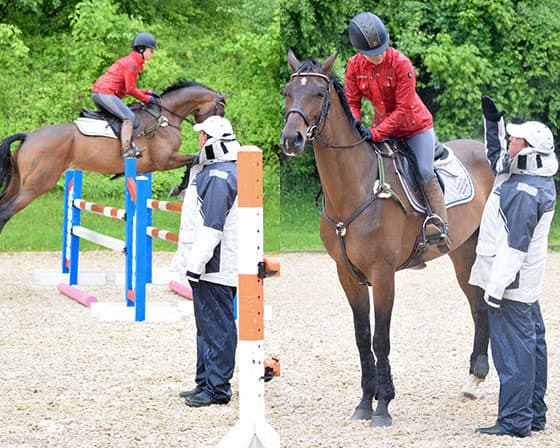
Early this week, legendary horseman and current U.S. chef d’equipe David O’Connor lead a USEA Instructor’s Certification Program (ICP) Workshop to prepare instructors for their upcoming level III/IV certifications. Hosted by Ms. Jacqueline Mars’ beautiful Stonehall Farm in The Plains, Va., O’Connor walked the group first through the fundamentals of show jumping, where he revealed many helpful tidbits and fun facts, which I call “O’Connorisms,” that can be beneficial for riders of all levels.
From the Start
No matter your jump height, experience level or competence in the saddle, the first thing you should focus on in the ring is safety. O’Connor explains, “Always set up for success, and in different situations ask yourself, ‘what if?’” Removing the extra jump cups from standards was one example O’Connor mentioned to create a safer environment. Having a properly fitted helmet and appropriate tack is also an easy way, as a rider, that you can set yourself up for a successful and safe jump school. Instructors should always be on the look out to make sure their students are always safely turned out, and that extra arena equipment - standards, jump pins, jump cups and extra poles - are not strewn across the arena. It is the little things that can make all the difference toward safety.
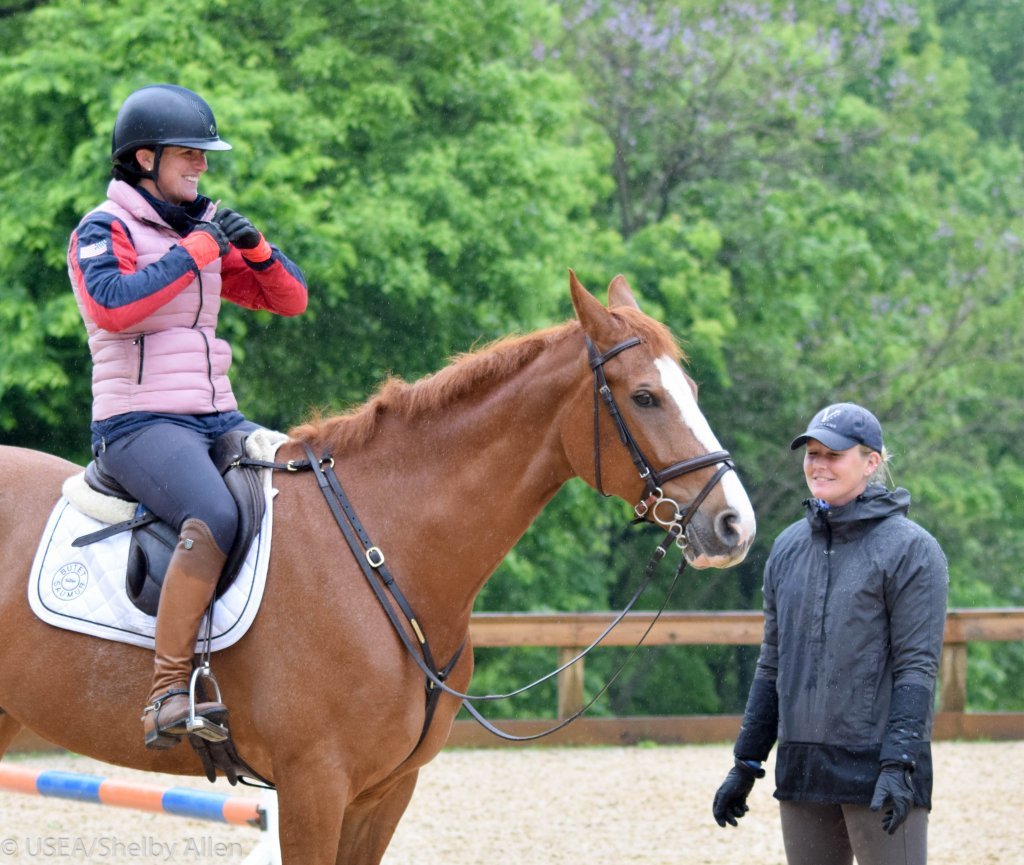
Even the best must be held accountable for safety. Here Lauren Kieffer is reminded by ICP workshop participant Clare VanderWoude to tighten her chin strap. USEA/Shelby Allen Photo.
Form Follows Function
There are three seat types that riders can use in show jumping: two-point, three-point and sitting. In two-point, riders have two points of contact with the saddle – their knee and lower leg/ankle, sitting is obviously being completely seated in the saddle, and three-point is a middle ground between the two where riders have a very light seat in the saddle (the seat is the third point of contact). O’Connor says all riders should be comfortable in each seat. “I make my riders practice the one they’re weakest in. In show jumping you don’t know which one you’re in, you find the one you’re in. Having the comfort between all three is very important for everyone. There is no ‘the seat’ – they have to have all three,” he elaborated.
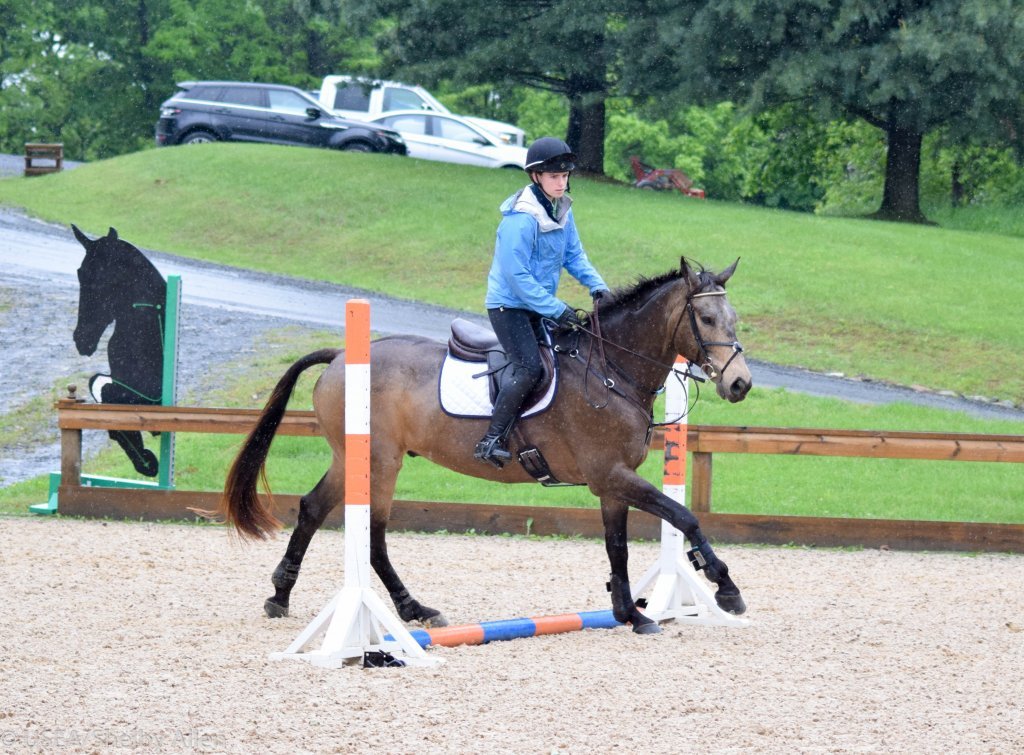
Liza Frazier demonstrates maintaining two-point throughout an exercise of ground rails. USEA/Shelby Allen Photo.
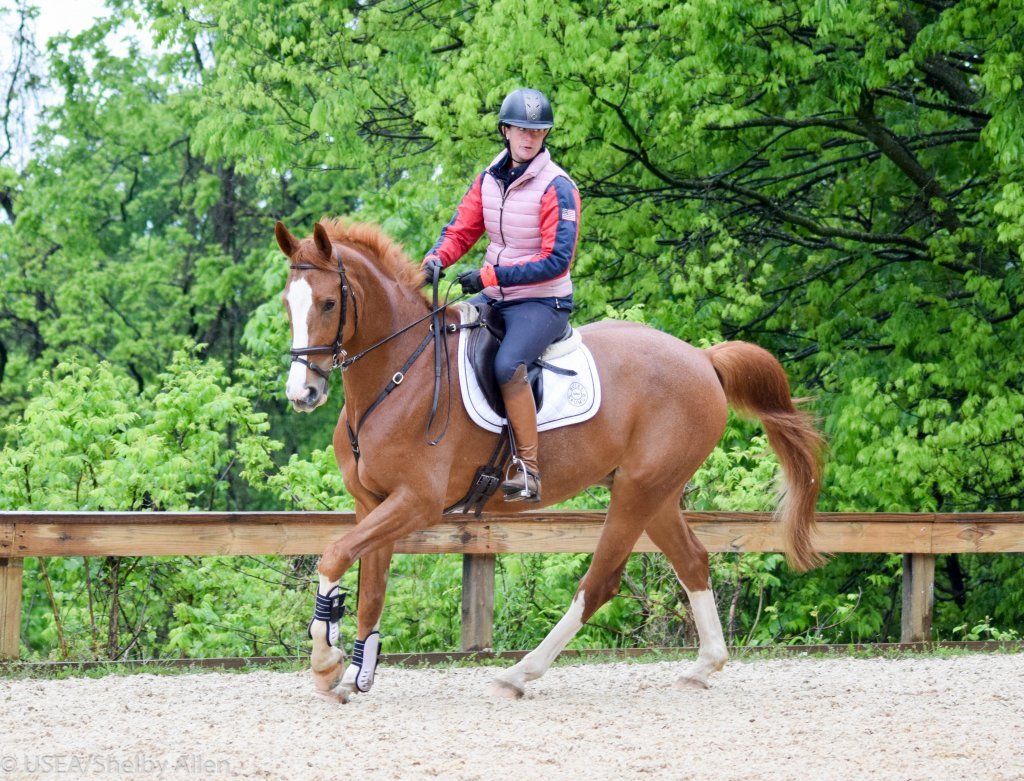
Lauren Kieffer demonstrates a sitting position in her approach. USEA/Shelby Allen Photo.
O’Connor also argues that he doesn’t see enough riders feeling very comfortable in two-point. “You need to be able to do 95% of the exercises you do in the dressage ring in two point,” he said. “You’re working in two-point, not just being in two-point.” So, whatever level you are, try practicing your dressage movements – shoulder in, leg yields, circles - in two-point to get even more comfortable out of the saddle.
Along with being comfortable and proficient in three seats while traveling along the arena, its equally as important that you maintain a secure position over the fences. Keeping the lower leg forward is essential to this secure position according to O’Connor. His suggestion to do this is to focus on your hips instead of your leg. “A lot of it has to do with where the hip is,” he said. “When the hip gets going forward, the leg gets going behind you. Think of sending your hips back and away.” He suggests riders and instructors work together to tweak and practice position changes at home over low fences. Your first adjustment may not be perfect, so keep at it!
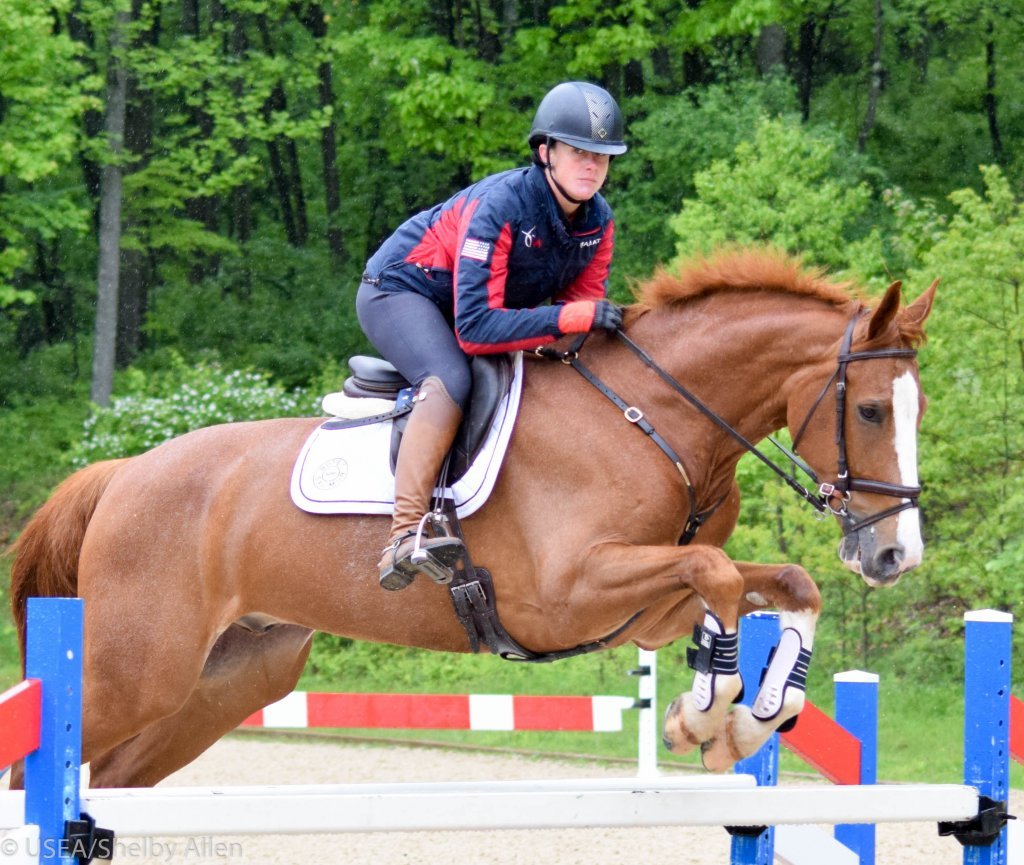
Lauren Kieffer demonstrates sending her hips backwards in order to have a more solid, forward lower leg. USEA/Shelby Allen Photo.
Establishing a secure lower leg will also help many riders to stay tall over fences. O’Connor says that especially for lower level riders, there may be no need to fold completely with your torso over fences. Keeping your lower leg forward, your hips back and your upper body tall, allows you to react more quickly on landing and you will therefore be better prepared for the next fence on course.
Stay tuned even more "O'Connorisms" in Part II where David O'Connor breaks down course work.
Related Articles
Bellissimo Tops Stable View CCI4*-S Aboard Dyri
Charles Pinnell, cross-country announcer, said it best—it was a “picture-perfect Saturday here in Aiken, South Carolina.” The day at Stable View started early with the remaining national divisions starting their weekend in the Tree Arena with dressage. The FEI divisions got underway promptly at 9...
Spring Has Sprung at the Stable View Spring International with Bellissimo Leading the CCI4*-S
The first day of the Stable View Spring International started off with a little bit of fog but quickly turned into a beautiful day. The 2/3/4* FEI divisions kicked off the day with the first riders going down the center line at 8:20 a.m.

United States Pony Club Continues Partnership with USEA in 2026, Championing Education and Development
The United States Eventing Association (USEA) is pleased to announce its continued partnership with the United States Pony Club (USPC) in 2026, renewing its role as the Presenting Sponsor of the USEA Eventing Coaches Program (ECP) Workshops. This ongoing collaboration highlights both organization...